

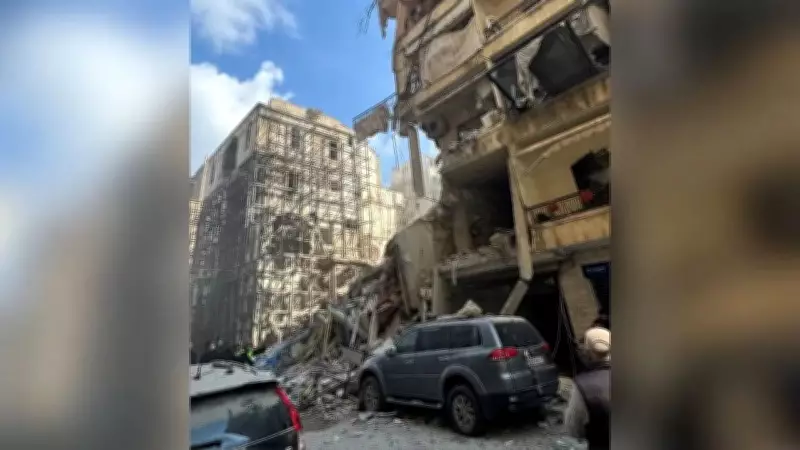
Heavy Israeli Bombing Hits Beirut, Forcing Lebanese University to Shift Classes Online
Some of the most intense Israeli airstrikes since the latest round of attacks began on March 2 targeted Beirut and other regions of Lebanon on Wednesday. According to Lebanese health ministry figures, the strikes resulted in at least 203 fatalities and more than 1,000 injuries. These attacks occurred despite a tentative ceasefire linked to the broader regional crisis, failing to halt Israeli military operations within Lebanon.
Educational Resilience in the Face of Conflict
Habib Al-Badawi, a professor of international relations and Japanese studies at Lebanese University, the country's sole state-run university, spoke to TOI from Beirut. He described how the bombings since last month have damaged educational institutions, compelling a shift to online teaching reminiscent of the Covid-19 pandemic. Witnessing the severe Wednesday bombings on residential buildings and other sites in Beirut, Al-Badawi condemned the attacks as an "unpardonable act against civilians."
"Despite these grave challenges, teachers and students have decided to continue teaching and learning by shifting the classes online, because education is the only way to raise our legitimate voices against the wrong," Al-Badawi stated. "We urge the Arab and international community to immediately intervene to save Lebanon from a bloody chess game."

Human and Institutional Toll on Higher Education
Al-Badawi emphasized that the conflict has exacted a heavy toll on Lebanese University, with losses spanning both human lives and institutional integrity. The university has reportedly lost three professors and seventeen students due to the bombings. Earlier reports had documented the deaths of two senior academics in an Israeli strike connected to the university's main campus in Beirut.
The professor explained that prior to the escalation of hostilities, class sizes at Lebanese University averaged around fifteen students per course. "Despite the ongoing conflict, a significant proportion of these students have demonstrated resilience by continuing to attend online sessions," he noted. However, he cautioned that this numerical continuity masks qualitative challenges affecting participation, including:
- Infrastructural disruptions
- Psychological strain and trauma
- Unequal access to stable digital connectivity
Severe Impact on Postgraduate Research and Schoolchildren
Al-Badawi highlighted that the disruption is particularly severe for postgraduate students, whose academic progress depends on sustained intellectual engagement, originality, and analytical rigor. "The prevailing environment of insecurity and psychological pressure has significantly constrained their capacity for advanced scholarly work," he said. "Unlike structured undergraduate learning, doctoral research requires a level of cognitive stability that is currently unattainable for many."
He warned that the cumulative effects of interrupted research, limited academic supervision, and broader systemic instability could reshape the trajectory of an entire cohort of scholars, with repercussions extending well beyond the cessation of hostilities.
The impact extends beyond higher education, severely affecting schoolchildren as well. Many public schools have been converted into shelters for displaced individuals, leading to the suspension of regular classes. "Beyond the logistical challenges, the social and emotional toll on children is considerable," Al-Badawi concluded. "The absence of physical schooling deprives them not only of formal education but also of essential developmental experiences—peer interaction, structured routines, and safe recreational spaces. In this sense, the conflict is not merely interrupting education; it is eroding critical dimensions of childhood itself."

Widespread Displacement and Daily Life Disruption
More than 1.2 million people have been displaced in Lebanon during the renewed conflict, with university facilities also being utilized to shelter civilians. This underscores how deeply the war has penetrated daily life, disrupting education, housing, and basic stability. Al-Badawi's urgent plea for international intervention highlights the desperate need to halt the attacks before further irreversible damage occurs.





