

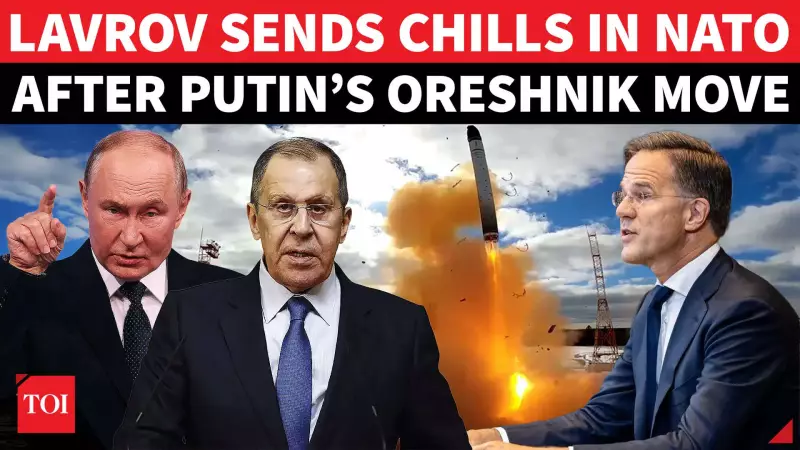
Panic has reportedly gripped NATO and European capitals following Russia's deployment of its advanced Oreshnik missile system near the European frontier. The move, which involves hypersonic-capable weaponry, has intensified fears of a potential direct confrontation and even a third world war.
Lavrov's Dual Message: Calm and Caution
In a recent interview with the Russian state news agency TASS, Foreign Minister Sergei Lavrov addressed the growing anxiety. He delivered a seemingly contradictory message, urging the Western military alliance not to fear while simultaneously issuing a stark warning. "NATO has no need to be afraid," Lavrov stated, but he immediately followed this by stressing that any attack on Russian territory would be met with a devastating and crushing response.
Lavrov's comments, made on December 28, 2025, are seen as a direct reinforcement of President Vladimir Putin's earlier warnings linked to the Oreshnik deployment. The diplomatic rhetoric appears designed to project strength and deterrence while managing the risk of unintended escalation.

EU Branded as Chief Obstacle to Peace
Shifting focus to the ongoing conflict in Ukraine, Lavrov launched a sharp critique against the European Union. He accused Brussels of being the primary obstacle to achieving peace in the region. According to the Russian Foreign Minister, the EU is not interested in diplomacy but is instead "openly preparing for war with Russia" by continuing to pump weapons and military aid into Kyiv.
Lavrov further alleged that European leaders had engaged in "cheating" former US President Donald Trump during his tenure, implying that EU policies undermined potential peace initiatives he might have pursued. This accusation adds a layer of historical grievance to the current standoff.
A Broader Context of Rising Tensions
These statements do not exist in a vacuum. They come at a time of heightened global instability:
- Peace talks regarding Ukraine have completely stalled, with no active diplomatic channels reported.
- Russia has made recent battlefield advances, altering the front-line dynamics.
- President Putin's latest military deployments, including the Oreshnik system, signal a readiness for a prolonged and escalated conflict.
- Renewed fears of a wider European war, or even a global conflict, are circulating among policymakers and analysts.
The combination of aggressive posturing, advanced weapon deployments, and the collapse of dialogue has created one of the most dangerous moments in East-West relations since the Cold War's end. Lavrov's interview, while aimed at a Russian domestic audience and framing Moscow as a reluctant actor forced to defend itself, is likely to deepen concerns in Western chancelleries about the Kremlin's ultimate intentions.






