

Iran's Advanced Missile Arsenal: A Strategic Enigma in the Gulf Conflict
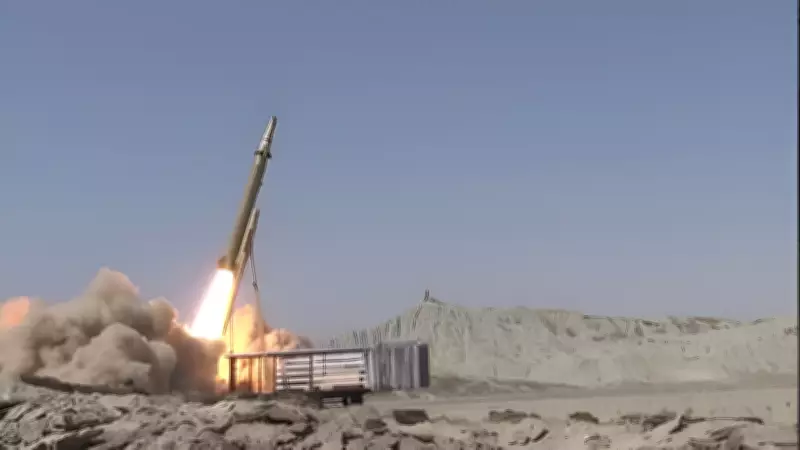
As missile attacks from Tehran continue to reverberate across the Middle East, a critical question emerges: where are Iran's most advanced missiles? Despite near-daily assaults, sophisticated systems like the Qassem Basir, Etemad, and Fattah-2 have been conspicuously absent from the battlefield, raising eyebrows among defense analysts and military experts worldwide.
The Unseen Arsenal: Qassem Basir and Beyond
According to a detailed Financial Times report, Iran's defense ministry proudly unveiled the Qassem Basir missile in May of last year, boasting its capability to strike enemies "wherever they are and whenever necessary." This formidable weapon features a manoeuvrable 500kg warhead and an optically guided "terminal seeker" that is immune to electronic jamming, positioning it as one of the most sophisticated assets in Iran's military inventory.
Yet, nearly a month into the intense conflict with Israel and the United States in the Gulf region, this advanced missile has not been deployed. The absence extends to other cutting-edge systems as well, creating a puzzling scenario for observers tracking the conflict's technological dimensions.

Expert Analysis: Why Hold Back Advanced Capabilities?
Military specialists propose several compelling theories for this strategic withholding. Jim Lamson, a senior research associate at the James Martin Center for Nonproliferation Studies and former CIA analyst, offers crucial insights. "Tehran may be holding some of its most capable systems in reserve, though inventories of these newer missiles are likely limited," Lamson explains.
The list of advanced systems still not seen in action includes:
- The Qassem Basir missile with its advanced guidance system
- The Etemad missile boasting an impressive 1700 km range
- A newer, enhanced version of the Emad missile
- The Fattah-2, which Iran claims utilizes a hypersonic glide vehicle that is extremely difficult to intercept
- The Raad-500, a short-range manoeuvrable missile
Experts suggest multiple possibilities for their absence: these missiles may have been destroyed in preemptive strikes, might not yet be fully operational, or could be deliberately held back for later stages of the conflict when enemy defenses have weakened through sustained engagement.
Current Battlefield Deployments: What Iran Has Actually Used
Iran's initial missile attacks relied predominantly on older, less advanced weaponry. However, as the conflict has progressed, Tehran has gradually introduced some of its newer systems into the fray. These include:
- The solid-fuel Sejjil missile
- The heavy Khorramshahr missile capable of carrying a two-tonne warhead
- The Kheibar Shekan, unveiled in 2022 with a one-tonne payload
Despite these deployments, the overall number of missiles being fired has decreased in recent days, with most being successfully intercepted by defense systems. This applies to both medium-range missiles aimed at Israel and shorter-range ones targeting Gulf locations.
Damage Assessment and Strategic Strikes
The United States and Israel have been aggressively targeting Iran's missile launchers to limit its offensive capabilities. According to Israeli Defense Forces assessments, approximately 200 of Iran's 470 launchers have been destroyed, with additional systems buried under relentless airstrikes.
Nevertheless, Iran has managed to achieve some successful hits, demonstrating persistent offensive capability. Notable strikes include:
- An attack on the Haifa refinery in Israel using a new missile system called Nasrallah
- A strike on the Ras Laffan liquefied natural gas facility in Qatar
The Diego Garcia Surprise: Extending Range Through Innovation
In a particularly notable development, Iran targeted the joint US-UK military base on Diego Garcia in the Chagos Islands using two heavy Khorramshahr missiles. While one failed mid-air and the other was intercepted, the attempt itself surprised military analysts.

The base sits approximately 4,000 kilometers away—far beyond the known range of most Iranian missiles. Analysts believe Iran may have reduced the weight of the warhead to extend the missile's range, demonstrating technical adaptability if not revolutionary capability.
Danny Citrinowicz, an Iran expert at the Tel Aviv-based Institute for National Security Studies, provides context: "I don't think they're hiding some decisive capability. The Diego Garcia strike was surprising, but it was more of a political signal than anything else. Technologically, if you can send a 1.5-ton warhead 2,000 kilometres, you can extend the range by reducing the payload—it's not a breakthrough."
The Strategic Calculus: Reserve Power or Limited Capability?
The absence of Iran's most advanced missiles presents a complex strategic puzzle. Tehran might be conserving its best systems for potential escalation or as bargaining chips in future negotiations. Alternatively, production limitations or technical challenges could be preventing widespread deployment of these sophisticated weapons.
As the conflict continues to evolve, the question of when—or if—these advanced systems will appear remains central to understanding Iran's military strategy and capabilities in the volatile Middle East theater.





