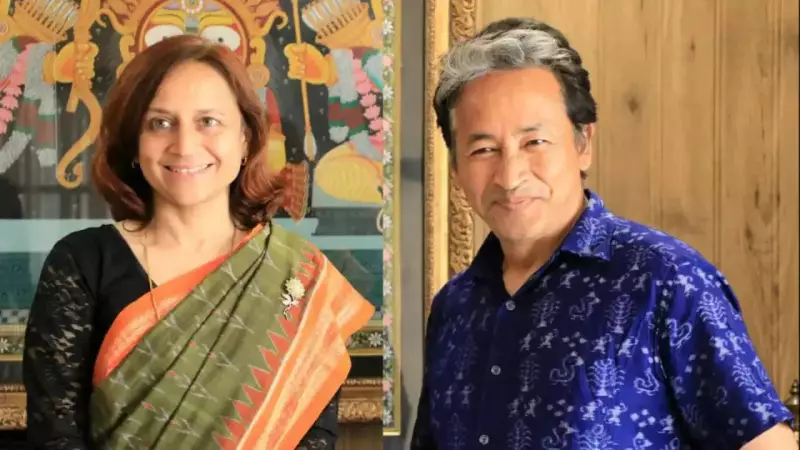
Climate activist Sonam Wangchuk's wife, Gitanjali Angmo, has shared details about his life in solitary confinement at a Jodhpur jail. She says he remains optimistic after more than three months behind bars.
Writing a Book Titled 'Forever Positive'
Angmo revealed that Wangchuk is using his time in custody to write a book based on his prison experience. The book will likely be called "Forever Positive." She explained this in an interview with PTI.
"So, the one good thing about positive and hopeful people is that they take everything in their stride," Angmo said. "But the conditions he lives in are very dire, very difficult. The book he's writing on his jail experience is likely to be titled Forever Positive."

Harsh Conditions in Solitary Confinement
Wangchuk sleeps on a blanket on the floor of a barrack with no furniture. He has very little space to walk. The activist has no access to phones, television, or watches.
Even newspapers brought by his family have reports related to him or Ladakh cut out. "When he sees the newspaper with those cuttings, he knows he must have featured there that day, or it must have been about Ladakh," Angmo said.
Finding Meaning in Observation and Reflection
Cut off from the outside world, Wangchuk has found meaning in observation and reflection. His wife shared that he has developed a fascination with ants.
"If he observes some ants and their behaviour, he asks me to get books on ant behaviour because the ant community has a lot of solidarity, a lot of team spirit," she said.
Structured Days and Reading Habits
Despite the restrictions, Wangchuk structures his days around reading, meditation, and physical discipline. He practises Vipassana, yoga, and Surya Namaskar.
He frequently asks for books on varied subjects. Angmo recalled giving him books such as Sri Aurobindo's account of his detention in Alipore jail to offer perspective.
"While giving him the book, I joked that just like Sri Aurobindo's enlightenment inside the jail, you should be a self-realised person when you come out. He said he would try his best," she said.
Wangchuk has also been reading several "feel-good" books. These include Jonathan Livingston Seagull and Mister God, This Is Anna. At one point, he even asked for books on sundials as he did not have a watch for a long time.
Family Dynamics and Personal Growth
Angmo said it was only after two months that Wangchuk told his family about the lack of basic facilities in the barrack. "For the first two months, we did not share the problems we were going through with each other. We presented a strong front," she explained.
She added that she, too, has tried to see her own struggles outside as a path of personal growth. "He makes the best of everything, and so he has made his life in jail a means for his progress," Angmo said.
Health and Basic Needs
On his health, Angmo said he remains content and mentally strong. "He is generally a very optimistic and hopeful person who sees the positive side of things," she noted. "He is very happy with less."
While the family is allowed to bring some fruits and homemade snacks, dried apricots are not permitted. "He has asked me many times to bring him sun-dried apricots, but they didn't allow it," Angmo said. She added that the basic jail food of dal, rice and vegetables does not bother him.
Jail Authorities and Background
The jail authorities have been cooperative within the limits of the law, according to Angmo. Some staff members have even approached Wangchuk for advice on parenting and education.
"I would say that they are doing their job; nothing against them. I appreciate all that they are doing for Sonam to the extent possible," she said.
Wangchuk, a well-known climate activist and innovator, has been lodged in jail for over 110 days. He was arrested on September 26 after ending a 15-day fast over demands related to statehood and Sixth Schedule status for Ladakh. His arrest followed violence in Leh, in which four people were killed.