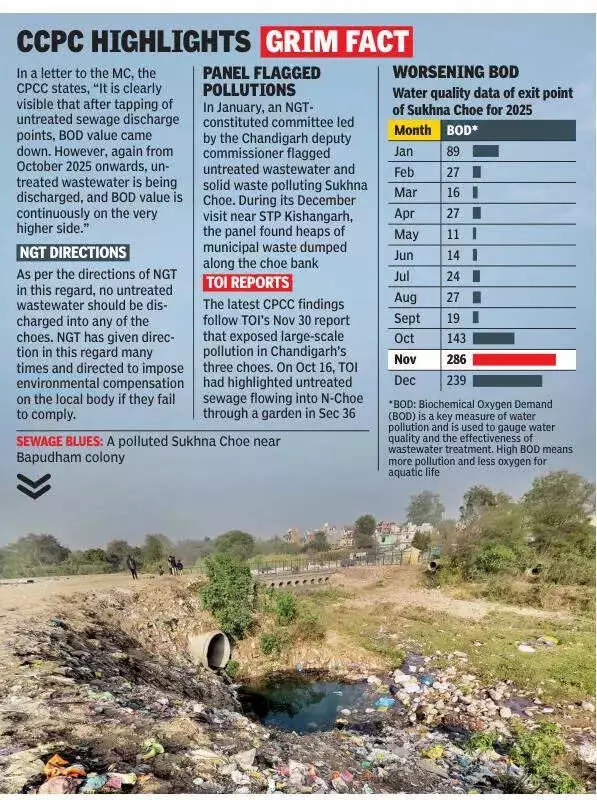
The seasonal Sukhna Choe in Chandigarh is once again fighting for survival, suffocated by a massive surge in pollution. A damning report from the Chandigarh Pollution Control Committee (CPCC) reveals that the Biochemical Oxygen Demand (BOD) level, a key indicator of organic pollution, has exploded from 19 in September to a staggering 286 in November 2025.
Alarming Data Points to Municipal Failure
The CPCC data paints a grim picture of rapid deterioration. After a significant improvement following earlier interventions, pollution levels have made a vicious comeback. The BOD level sharply jumped to 143 in October, more than doubled to 286 in November, and remained dangerously high at 239 in December. The committee has squarely put the Chandigarh Municipal Corporation on notice for the continuous discharge of untreated wastewater into the choe, directing it to take immediate corrective action.
In a letter to the civic body, the CPCC stated, "It is clearly visible that after tapping of untreated sewage discharge points, BOD value came down. However, again from October 2025 onwards, untreated wastewater is being discharged, and BOD value is continuously on the very higher side." This confirms warnings raised earlier by The Times of India regarding unchecked pollution in the city's water channels.

A Recurring Nightmare Defying NGT Orders
This is not a new problem but a persistent environmental failure. The National Green Tribunal (NGT) has repeatedly directed that no untreated wastewater should be discharged into any of Chandigarh's choes. The tribunal has even warned of imposing environmental compensation on the local body for non-compliance. Despite these orders and previous CPCC directives in October, the mixing of sewage water has been observed again in the Sukhna Choe.
The issue extends beyond Sukhna Choe. Recent visits to the border where the N-Choe, Patiala Ki Rao, and Sukhna Choe exit Chandigarh for Mohali district revealed large-scale pollution in all three streams. Trailing upstream the Sukhna Choe from Baltana in Zirakpur to the Chandigarh border, slushy dark water flowed with a strong, suffocating smell. The situation downstream in Baltana worsens with heaps of garbage dumped into the choe, compounded by polluted inlets from the Panchkula area.
Committee Findings and a History of Neglect
Earlier this year, an NGT-constituted joint committee headed by the Chandigarh deputy commissioner also found the Sukhna Choe polluted by untreated wastewater and solid waste. During a visit in December, the committee discovered two small heaps of municipal solid waste disposed of at the choe bank between its origin point and the Kishangarh Bridge. While corrective steps were reportedly taken, the latest CPCC data suggests the core issue of sewage discharge remains unresolved.
The CPCC's latest findings come close on the heels of TOI reports highlighting large-scale pollution in the three choes. A November 30 report focused on the pollution crisis, while an October 16 report specifically highlighted sewage flowing into the N-Choe through the Hibiscus Garden in Sector 36. The Sukhna Choe's plight underscores a systemic failure in wastewater management and enforcement, turning a seasonal rivulet into a toxic drain and raising serious questions about civic accountability and environmental governance in the Union Territory.