

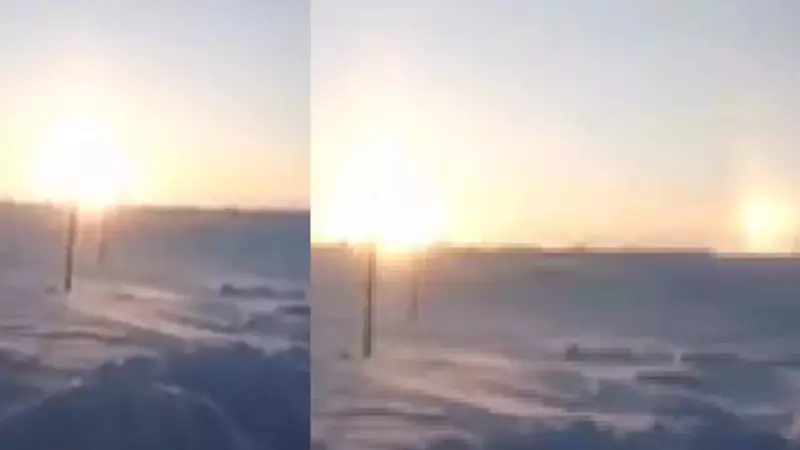
Russia's Sakhalin Region Witnesses Rare 'Two Suns' Optical Illusion
Residents of Russia's Sakhalin region were recently treated to a surreal and breathtaking sight: what appeared to be two suns rising side by side in the morning sky. This stunning visual spectacle quickly went viral across social media platforms, captivating viewers with its otherworldly appearance. However, this is not some celestial anomaly or supernatural event—it is a well-documented atmospheric optical phenomenon known as a sundog.
Understanding Sundogs: The Science Behind the 'Mock Suns'
Sundogs, also referred to as mock suns or parhelia, form when sunlight interacts with hexagonal ice crystals suspended in the atmosphere. These crystals are most commonly found in high cirrus clouds or as diamond dust under extremely cold conditions. When the sun's rays pass through and are refracted by these ice crystals, they create bright, often colorful spots flanking the actual Sun. The term "parhelia" literally translates to "beside the Sun," derived from the Greek words 'para' (beside) and 'helios' (Sun), making it a fitting description for this phenomenon.
How Sundogs Form: The Atmospheric Mechanics
At the core of every sundog are flat, hexagonal ice crystals lofted high in the atmosphere, typically in cirrus or cirrostratus clouds at altitudes ranging from 20,000 to 40,000 feet. In very cold climates, these crystals can also occur as "diamond dust" at lower altitudes when temperatures plummet below minus 30 degrees Celsius. As these plate-like crystals fall, they align horizontally with slight wobbling due to air currents. When sunlight enters one face of the crystal and exits another at a 60-degree angle, it undergoes double refraction, bending the light at approximately 22 degrees. This explains why sundogs appear at the same height above the horizon as the Sun.

Colors, Shapes, and the Physics of Sundogs
Sundogs are not typically bright white; they often display vibrant colors due to the dispersion of sunlight. The area closest to the Sun usually shows shades of red, which gradually transition to orange, yellow, and blue at the edges. This color spectrum results from different wavelengths of light refracting at varying angles—red light, with its longer wavelength, bends less than blue light, creating a sideways rainbow effect reminiscent of ROY G. BIV. The size and shape of sundogs can vary based on crystal size and atmospheric conditions, sometimes extending into partial or complete 22-degree halos.
Ideal Conditions for Observing Sundogs
While sundogs can occur anywhere in the world when the Sun is above the horizon, their visibility depends on specific atmospheric conditions. A low Sun—during sunrise or sunset—enhances the phenomenon as light passes through ice crystals at shallower angles, producing more pronounced bright spots. Cold weather plays a crucial role, with sub-zero temperatures at higher latitudes increasing the likelihood of hexagonal ice crystal formation. Sakhalin's frigid winters provide ideal conditions for witnessing this rare optical illusion.
Historical and Scientific Significance of Sundogs
Before the scientific understanding of light refraction and dispersion, sundogs inspired numerous myths and legends, often viewed as omens or divine signs. Pioneering experiments by scientists like Sir Isaac Newton have since demystified the phenomenon, providing in-depth knowledge of its optical principles. The recent display in Sakhalin serves as a reminder of how ordinary sunlight, when interacting with natural elements like ice crystals, can create extraordinary visual experiences, highlighting the beauty and complexity of atmospheric optics.






