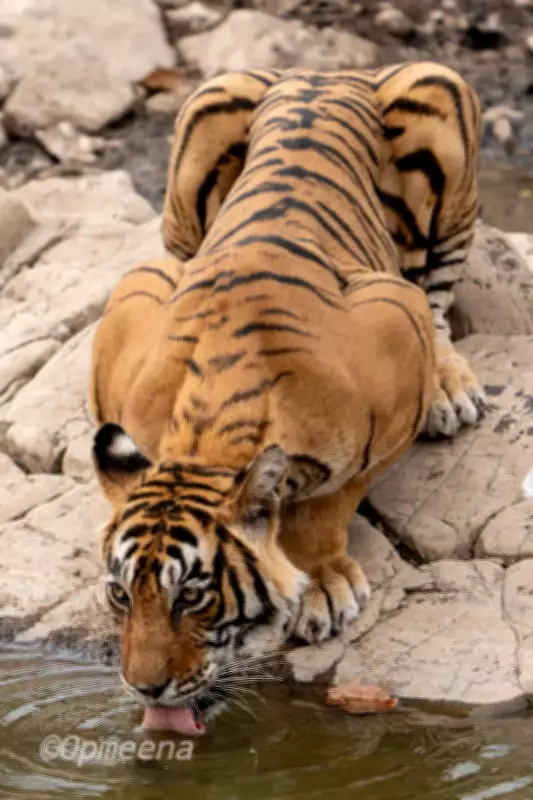
Ranthambore's Legendary Tigress T-39 Sparks Alarm with Highway Sighting
In a development that has stirred concern among wildlife enthusiasts and local residents, Tigress T-39, famously known as Noor, one of the oldest surviving big cats in Rajasthan's Ranthambore National Park, has been observed moving along the reserve's outer boundaries. Recent sightings near National Highway-552 have prompted forest authorities to ramp up monitoring efforts to ensure her safety and that of the public.
A Remarkable Life Span in the Wild
Born in 2007, T-39 is approximately 18 years old, placing her among the longest-living tigresses currently recorded in Ranthambore, according to Manas Singh, the Divisional Forest Officer (DFO) of Ranthambore. Forest officials emphasize that tigers rarely achieve such an advanced age in the wild due to factors like territorial conflicts, scarcity of prey, and natural decline. Remarkably, T-39 has survived entirely under natural conditions, without any medical intervention or human assistance.
A wildlife enthusiast highlighted her significant contributions, noting, "Over her lifetime, she has produced five litters and successfully raised 11 cubs, bolstering the tiger population within the Ranthambore landscape. Her longevity is often compared to earlier iconic tigresses like Machchli, though T-39's life has remained entirely within the park's natural parameters."

Shift in Movement Patterns and Health Concerns
In recent weeks, officials have documented a noticeable shift in T-39's movement patterns. "The tigress is now frequently sighted in fringe areas, including the Range of Project Tiger (ROPT) and Phalodi range, indicating reduced territorial control and a search for less competitive space," explained a forest staff member. Late at night, she was spotted near NH-552 close to Bodal village on the Sawai Madhopur–Sheopur route. Forest teams tracked her throughout the night and confirmed that she eventually retreated back towards the forest.
Officials have observed that T-39 appears physically weakened and has been seen limping. "Her movement towards human-use areas is being linked to difficulty in securing prey and water within her core territories," the staff member added. This behavior underscores the challenges faced by aging wildlife in maintaining their dominance and survival.
Past Incidents and Current Monitoring Efforts
In an earlier incident, officials reported that T-39 killed livestock near the same highway and remained in the vicinity for several days, which heightened caution among commuters. In response, the forest department has deployed multiple teams to closely monitor her movements. Residents in nearby areas have been advised to remain vigilant and restrict night-time activities as tracking operations continue.
Context of Longevity in Ranthambore Tigers
Tiger expert Abhishek Chaudhary provided context, stating, "Other big cats in Ranthambore National Park have also reached or approached the 20-year mark. For instance, Tigress T-8 Ladli, who was around 21 years old, went missing from the Kushalipura area about a year ago, while T-13, which had crossed 20 years, was last recorded in the Karnapur region nearly two years earlier." This highlights that while T-39's age is exceptional, it is part of a broader pattern of longevity among some tigers in the park, though such cases remain rare and are often fraught with challenges as they age.
The situation with T-39 serves as a poignant reminder of the delicate balance between wildlife conservation and human activities, urging continued efforts to protect these majestic creatures in their natural habitats.