

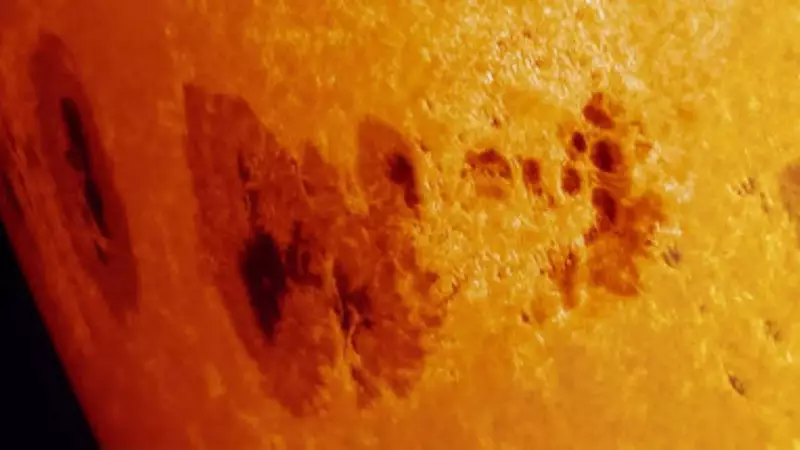
The dawn of December 2025 has been marked by a dramatic surge in the Sun's activity, forcing scientists and space weather experts to turn their full attention to our star. An intense solar flare, classified as X2-class, erupted in the early hours of Monday, December 1, serving as a stark reminder of how solar storms can directly impact technology on Earth. This event originated from an unexpected, small sunspot, highlighting the unpredictable nature of our Sun's magnetic behaviour.
Unexpected Eruption from a Small Sunspot
The powerful flare was recorded at 0249 UTC on 1 December 2025. Surprisingly, it did not come from the massive, attention-grabbing sunspot group in the southern hemisphere. Instead, it burst forth from northern sunspot 4295, a relatively small and unremarkable feature. This demonstrates that even modest-looking regions on the Sun can harbour immense magnetic tension that releases energy without much visible warning.
The immediate consequence on Earth was a significant shortwave radio blackout, centred primarily over Australia. The flare's intense pulse of radiation rapidly ionised the upper atmosphere, disrupting the ionospheric layers that reflect high-frequency radio signals used for long-distance communication. Early data also hints that the flare may have launched a coronal mass ejection (CME) toward Earth. If confirmed, this cloud of charged solar plasma could lead to geomagnetic storms, affecting satellites, navigation systems, and even power grids in the days ahead.

Why More Powerful Flares Are Expected This Week
Monitoring agencies warn that the December 1 event is likely just the beginning. The solar disk currently hosts several magnetically complex regions capable of producing more high-energy eruptions. The primary focus is on the gigantic sunspot complex labelled 4294-96. This sprawling region exhibits a dangerous magnetic configuration known as beta-gamma-delta, which is frequently linked to the most powerful X-class flares.
Research cited by SpaceWeather.com indicates that sunspot groups showing rapid changes in magnetic polarity are prone to sudden, explosive energy releases. The 4294-96 complex fits this description perfectly, displaying clear signs of magnetic stress as it rotates to face Earth directly. Any major flare from this region would be geoeffective, meaning its radiation and particles would head straight for our planet, increasing the risk of technological disruptions for sectors relying on satellites and HF communication in the coming days.
The Massive Sunspot Group Stealing the Show
What makes the current solar situation particularly noteworthy is the sheer scale of the sunspot complex 4294-96. Stretching approximately 180,000 kilometres across, it ranks among the largest such formations observed in the past decade. Several of its dark cores are larger than Earth itself, making it visible to amateur astronomers with properly filtered telescopes.
Interestingly, this colossal group was spotted days before it came into Earth's view by a distant observer: NASA's Perseverance rover on Mars. The rover captured images of the sunspot through the dusty skies of Jezero Crater. Sunspots are cooler, darker areas where powerful magnetic fields inhibit the Sun's normal heat flow. In a complex of this size and complexity, magnetic fields can twist and reconnect violently, releasing vast amounts of energy as radiation (flares) and plasma (CMEs). This volatile region sets the stage for continued solar activity.
Impacts on Technology and Ongoing Vigilance
The effects of the December 1 flare clearly show how space weather ripples down to Earth. The radio blackout over Australia exposed the vulnerability of global communication networks. A subsequent CME could increase atmospheric drag on satellites in low orbit and induce currents in long-distance power lines, though the severity would depend on the storm's strength.

With the combination of an active northern sunspot and the massive, unstable southern complex, space weather forecasters are on high alert. Continuous observations from solar observatories and spacecraft will be crucial in predicting flare probabilities and preparing for potential geomagnetic consequences. The start of December 2025 underscores our growing dependence on technologies that are inherently tied to the calmness of our space environment.





