

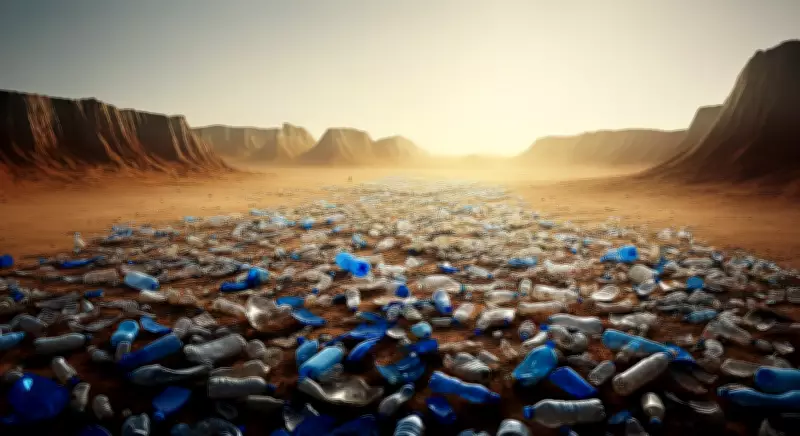
The plastic water bottle is barely over fifty years old, yet it may end up being one of the most enduring objects humans have ever created. The clear PET bottle used for water and soft drinks today traces back to a patent granted to DuPont engineer Nathaniel Wyeth in 1973, describing what he called a biaxially oriented polyethylene terephthalate container. Within a decade, PET had replaced glass across most of the global beverage industry, prized for being light, unbreakable, and cheap to mass-produce. By 2024, an estimated 480 billion PET bottles were being manufactured every year, close to one million every minute. The same chemical stability that makes PET so useful, however, is also why scientists are now finding fragments of it in some of the most remote corners of the planet.
How long does it take a plastic bottle to decompose?
The commonly cited figure for plastic bottle decomposition is around 450 years, a number compiled from research used by the NOAA Marine Debris Program to compare degradation timelines of different kinds of ocean litter. Since PET has only existed for about fifty years, no bottle has actually been observed completing this process, and the figure is an extrapolation based on degradation rates measured under laboratory conditions. What is certain is that a plastic bottle does not vanish the way a banana peel or a sheet of paper does. It simply takes far longer for any visible trace of it to disappear, and even then, what remains does not go away it changes form.
From solid plastic to microplastics: Why decomposition doesn't mean disappearance
Natural materials like wood, cotton, or animal tissue are broken down by bacteria and fungi that have evolved enzymes capable of digesting their molecular structure. Synthetic polymers like PET are chemically unlike anything that existed in nature before the twentieth century, so no microorganism has evolved the ability to break their bonds efficiently. Instead, sunlight, heat, and physical wear slowly turn a bottle brittle, causing it to crack into smaller and smaller pieces first into fragments, then into microplastics under five millimetres, and eventually into nanoplastics invisible to the naked eye. The plastic hasn't disappeared; it has simply been redistributed into billions of smaller pieces that retain the same basic chemical makeup as the original bottle.

Microplastics in Arctic snow and alpine ice: What researchers discovered
Just how far these fragments travel became clear through a 2019 study by researchers at the Alfred Wegener Institute, which examined snow collected from ice floes in the Fram Strait between Greenland and Svalbard, as well as from the Swiss Alps and parts of Germany. Microplastic particles were detected in nearly every sample, including those from the high Arctic, thousands of kilometres from any major source of plastic waste. The researchers concluded that the particles had likely been carried through the atmosphere on wind currents and deposited through snowfall, much like pollen travels across continents.
Airborne microplastics in the Pyrenees: A remote mountain catchment study
A separate piece of research, published in Nature Geoscience in 2019, looked at a monitoring station in the French Pyrenees, more than 100 kilometres from the nearest city. Over a five-month sampling period, the station recorded an average of roughly 365 microplastic particles falling per square metre every day, most of them fragments resembling single-use packaging material. Modelling of wind patterns indicated that these particles had travelled through the atmosphere for at least 95 kilometres before settling on the mountain catchment, demonstrating that microplastic fallout is not confined to cities or coastlines.

Microplastics in the Mariana Trench: Plastic pollution reaches the deep ocean
The dispersal pattern extends downward as well as outward. A 2019 study in Royal Society Open Science examined amphipods, small shrimp-like crustaceans, collected from six deep ocean trenches around the Pacific Rim, including the Mariana Trench at depths of nearly 11,000 metres. The study found microplastic fragments in 72 percent of all specimens examined, and in 100 percent of those collected from the Mariana Trench specifically. The fibres and fragments identified included materials such as nylon, polyethene, and polyvinyl chloride the same broad categories of plastic used in everyday packaging, now present in the digestive tracts of creatures living in total darkness at crushing pressure.
The scale of global plastic production: 8.3 billion tonnes and counting
To understand why microplastics have spread so completely, it helps to look at the bigger picture. A landmark 2017 study estimated that around 8.3 billion tonnes of virgin plastic had been produced globally since 1950, of which roughly 6.3 billion tonnes had already become waste by 2015. Of that waste, only about 9 per cent had been recycled and 12 per cent incinerated, leaving close to 79 per cent sitting in landfills or scattered across the natural environment.
Taken together, this body of research paints a fairly stark picture. The first PET bottles made in the late 1970s have, by most estimates, completed only a small fraction of their decomposition cycle even today. Most of the plastic ever produced is still here in some form, intact, fragmented, or reduced to particles drifting through snow, rivers, and ocean sediment and will likely remain part of the planet's environment for centuries to come.
This article was originally published by the TOI Science Desk and has been rewritten for clarity and context.





