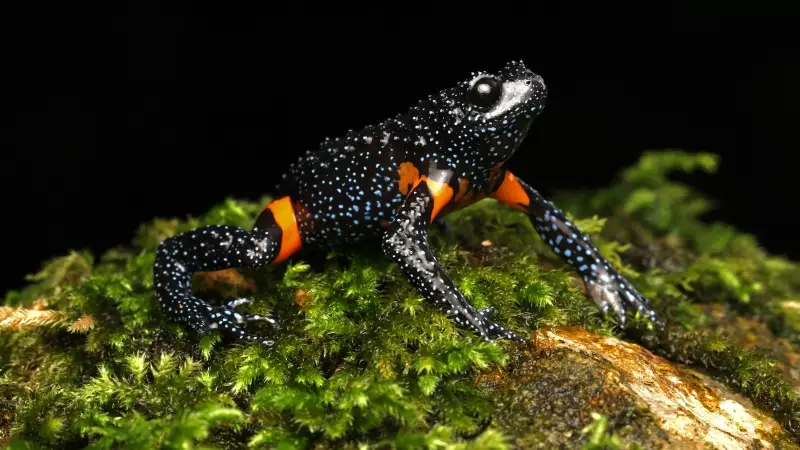
A shocking new scientific report has directly linked the disappearance and presumed death of seven of the world's rarest amphibians – the galaxy frog – to a surge in unethical wildlife photography in Kerala's Western Ghats. The study, published in December 2025, details how the tiny, star-patterned frogs vanished after their sensitive microhabitat was repeatedly disturbed by photographers seeking the perfect shot.
The Vanishing Act of the Cosmic Frog
The galaxy frog (Melanobatrachus indicus) is an extraordinary creature. No bigger than a human fingertip, its jet-black skin is adorned with pale blue speckles that look like a starry night sky, accented by fiery orange patterns. This elusive amphibian lives exclusively under rotten logs in a very specific region of the Western Ghats in Kerala and is listed as vulnerable to extinction by the International Union for Conservation of Nature (IUCN).
The tragic incident began in March 2020, when lead researcher K P Rajkumar and his team, monitoring the species with Kerala Forest Department approval, discovered a group of seven galaxy frogs in a forest patch. The Covid-19 pandemic forced the researchers to pause their work. However, between June 2020 and April 2021, the site was inundated with photographers.

"The photographers were familiar with the microhabitat of the species from publications and local trackers, and overturned many logs whilst searching for the species," the study states. When Rajkumar's team returned in August 2021, the scene was devastated: logs were displaced, vegetation trampled, and the frogs were gone.
How Photography Sessions Became a Death Sentence
Local accounts provided a grim picture of the disturbances. Photographers allegedly captured the frogs with bare hands, moving them to moss or other logs for better backgrounds. The amphibians were subjected to high-powered camera flashes for sessions lasting nearly four hours. An informant even claimed two frogs died during these marathon shoots, though researchers could not independently verify this.
Varad Giri, a frog expert with the Reliance Foundation, explained the severe impact of such handling. "Frogs use their skin for respiration... If their skin becomes dry (which can happen due to heat transfer while handling frogs or using flash to photograph them), their activity will be hampered, as they will not be able to breathe comfortably," Giri told The Indian Express. Furthermore, bare-hand contact risks transferring human pathogens to the amphibians, potentially causing lethal diseases.
By dislodging the logs, the photographers destroyed the precise microclimate of humidity and temperature the cold-blooded frogs depend on. The study concluded that this alteration likely prevented the frogs from ever returning to their home, disrupting feeding and breeding. Subsequent searches in November 2021 and May 2022 found no trace; all seven are now presumed dead.
A Call for Ethical Standards and Respect for Nature
The report, titled 'Unethical wildlife photography imperils the Western Ghats endemic galaxy frog', serves as a stark warning. Authored by fellows from the Zoological Society of London and P S Easa of the Aranyakam Nature Foundation, it highlights photo tourism as a new and significant threat, especially after the galaxy frog was named the flagship species of Mathikettan Shola National Park in 2021.
The study urgently calls for establishing ethical standards in conservation photography. These should include restricting the capture, handling, and chasing of animals, minimizing the use of high-intensity lights with diffusers, and avoiding any disturbance to microhabitats. It suggests forest and tourism departments collaborate to train guides and tour operators who work with photographers.
Echoing the sentiment for greater respect, Varad Giri advises that the best approach for such rare species is to leave them undisturbed. "If someone loves nature, they should respect it. Just for clicks, they should not disturb the animal to the extent that it creates problems," he asserts. The fate of the seven galaxy frogs underscores that the quest for a perfect photograph can sometimes have a perfectly tragic outcome.