

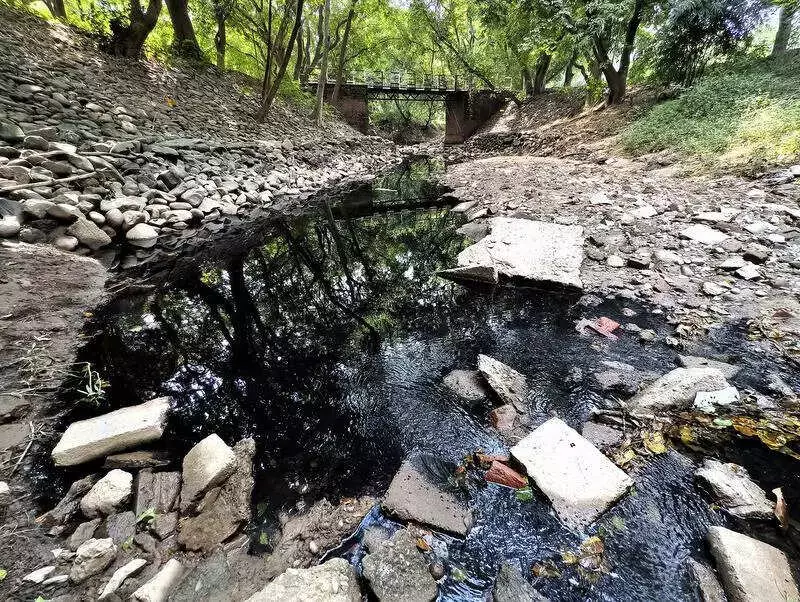
The alarming pollution plaguing Chandigarh's seasonal streams, known as choes, has now echoed within the halls of Parliament. Local MP Manish Tiwari on Monday directly questioned the Ministry of Environment, Forest and Climate Change (MoEFCC) regarding the "unchecked pollution" in the N-Choe, bringing a critical local issue to national attention.
Ministry Admits to Wastewater Discharge in N-Choe
In a significant admission, the MoEFCC responded that the Chandigarh Pollution Control Committee (CPCC) had reported instances of wastewater discharge into the N-Choe over the past year. The ministry stated that the CPCC subsequently directed the Chandigarh Municipal Corporation to implement corrective measures to halt waste disposal into the water body.
This parliamentary exchange follows a series of news reports by TOI, which first highlighted the large-scale contamination in the city's three major choes – N-Choe, Patiala Ki Rao, and Sukhna Choe. A specific report on October 16 had already exposed sewage flow into the N-Choe near Hibiscus Garden in Sector 36.

Inspection Reveals Broken Pipelines and Waste Dumping
Detailing the events, the ministry's reply referenced an inspection carried out in January 2024. During this visit to Sector 36, the CPCC observed that a previously broken sewage pipeline crossing the N-Choe drain had been repaired. However, the inspection also noted a heap of solid and construction & demolition waste dumped on the drain's bank near the Hibiscus Garden.
While Tiwari also had questions concerning pollution in the Sukhna Choe and Patiala Ki Rao, these supplementary queries could not be raised due to disruptions in Parliament proceedings.
Long-Term Solutions and Accountability Questions Remain
In response to queries about directives from the National Green Tribunal (NGT) or CPCC, the ministry confirmed that the municipal corporation was instructed to take corrective actions. The CPCC also asked the engineering department to install iron nets on culverts near roads to prevent people from dumping solid waste into the choe.
Regarding sewage management, the ministry informed that Chandigarh is serviced by eight Sewage Treatment Plants (STPs) with a total capacity of 253.5 million liters per day (MLD), against a current wastewater generation of approximately 232 MLD. However, a critical monitoring gap was revealed: out of the eight STPs, only two have their Online Continuous Effluent Quality Monitoring Systems (OCEMS) connected to the Central Pollution Control Board (CPCB) server. The CPCC has issued directions to the Municipal Commissioner to ensure this connectivity.
On the crucial issue of restoring the natural watercourse, the ministry delivered a disappointing update: no specific proposal for the rejuvenation or restoration of the N-Choe has been made in the last three years. Furthermore, the ministry remained silent on Tiwari's pointed question about fixing accountability for the repeated environmental violations leading to untreated sewage discharge into these natural streams.
The parliamentary discussion underscores a persistent environmental and public health challenge in Chandigarh, where systemic gaps in monitoring, infrastructure maintenance, and long-term planning continue to threaten the city's seasonal waterways.






