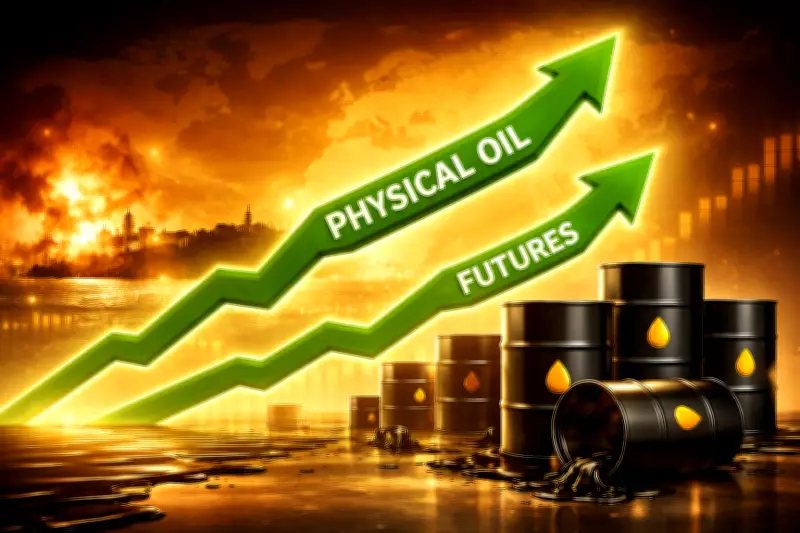
Global Oil Markets Show Sharp Split as Iran War Enters Fourth Week
The ongoing conflict between Israel and Iran has now entered its fourth week, triggering a significant divergence in global oil markets. While widely tracked oil futures have surged, the actual prices for physical fuel supplies are climbing at an even more alarming rate, highlighting severe supply disruptions and economic pressures.
Supply Shock Drives Prices Higher
Brent crude, the global benchmark for oil, has skyrocketed by over 50% to approximately $112 per barrel. This sharp increase follows the near-total closure of the Strait of Hormuz, a critical maritime chokepoint, and repeated attacks on energy infrastructure across the Middle East. However, the cost of physical oil, which is refined into essential products like petrol, diesel, and jet fuel, has risen even more dramatically as securing supplies becomes increasingly difficult.
Refiners in Asia are now forced to pay steep premiums above Brent prices to source cargoes from distant regions, underscoring the acute shortage. According to Bloomberg, this disparity is partly due to measures by countries to control price rises, such as releasing emergency stockpiles. Yet, the broader impact on the global economy appears far more severe than what futures markets indicate.

Economic Strain Spreads Across Sectors
The ripple effects of this oil market split are being felt widely. Trucking companies are grappling with higher fuel bills, some shipping firms are reducing purchases, and airlines in Europe have warned that soaring jet fuel prices—now exceeding $200 per barrel—will inevitably be passed on to passengers. In the United States, petrol prices are nearing $4 per gallon, while diesel has crossed $5, adding to inflationary pressures.
Jeff Currie, chief strategy officer of energy pathways at Carlyle Group Inc., commented to Bloomberg, “You look at the paper markets, they’ve entirely disconnected from the physical markets... We’re dealing with an enormous supply shock.” This sentiment is echoed by analysts from Goldman Sachs Group Inc. and Citigroup Inc., who predict that oil futures could surpass the previous record of $147.50 set in 2008 if the conflict persists.
Unprecedented Disruption and Limited Options
The International Energy Agency has described this situation as the biggest oil supply shock ever recorded. Goldman estimates that about 17 million barrels per day flowing through the Persian Gulf are being affected, with Brent crude briefly approaching $120 per barrel twice in recent weeks—a level last seen in 2022. This has intensified pressure on governments to act.
U.S. Treasury Secretary Scott Bessent has indicated that the country might consider another release from its strategic reserves, following a major recent drawdown. He also announced a one-month waiver on sanctions for Iranian oil in transit until April 19. Other steps include managing Russian oil shipments and denying speculation about U.S. intervention in futures markets. However, high market volatility has made trading more expensive, limiting activity and keeping futures prices somewhat restrained, though insufficient to offset supply shortages.
Christof Ruhl, a global advisor at Crystol Energy and former BP Plc economist, stated in a Bloomberg TV interview, “The US has almost exhausted the arsenal for stopping prices from rising, given this degree of uncertainty, if the strait isn’t opened and the uncertainty of physical damage isn’t removed... So there isn’t much they can do.”
Regional Impacts and Ongoing Conflict
Signs of strain are evident across various economies. Shipping companies are imposing fuel surcharges, while some buyers delay large purchases due to price swings. In Germany, heating oil sellers report that consumers are buying only “when absolutely necessary,” and airlines have canceled flights as fuel costs rise. Pavel Kveten, CEO of Girteka Logistics, a top European trucking firm, noted that fuel constitutes about 30% of their transport costs, with energy market movements impacting their cost base immediately.

The scramble for available crude is also driving up regional prices. Oman crude has exceeded $162 per barrel, and Murban crude from the United Arab Emirates has moved above $145. Asian buyers have ramped up purchases of U.S. oil to the highest level in three years as they seek alternatives to disrupted Middle Eastern supplies.
Meanwhile, in the Middle East, there are no clear signs of the conflict easing. Iranian officials are reportedly reluctant to discuss reopening the Strait of Hormuz amid ongoing attacks, according to a source involved in high-level contacts with Tehran. Helima Croft, an analyst at RBC Capital Markets LLC, remarked in a note, “We see little relief for the deepening energy crisis as more energy facilities come under fire... Administration officials have spent considerable manhours working to convey to market participants that the disruption will be short-lived as the war will soon wind down. Yet nothing points to a limited engagement at this juncture.”
As the war continues, the global economy faces mounting challenges from this unprecedented oil market split, with further price increases looming if the situation does not improve soon.