NGT Amicus Exposes High Pollution Levels in Chandigarh Stormwater Drains
Contrary to optimistic compliance assertions from the Union Territory administration, the amicus curiae appointed by the National Green Tribunal has identified alarmingly elevated concentrations of faecal coliform, total coliform, and biochemical oxygen demand across all four major stormwater drains in Chandigarh. These critical findings emerge from a review of the latest compliance affidavit submitted by Chandigarh authorities in a case pertaining to the Municipal Solid Waste Management Rules of 2016 and associated environmental matters.
Discrepancies in Sewage Interception Claims
The UT administration had confidently reported the successful interception of all wastewater discharge points into the seasonal rivulets, known locally as choes. Specifically, officials claimed to have identified and tapped 17 discharge points in Sukhna Choe, 19 in N-Choe, and six in Patiala ki Rao. However, the amicus curiae has highlighted a stark contradiction, noting that sewage continues to infiltrate these water bodies. Faidan Choe is openly acknowledged as receiving sewage that ultimately flows into the Ghaggar river, undermining the administration's assertions of effective pollution control.
Broader Waste Management Deficiencies Under Scrutiny
Beyond the immediate issue of sewage contamination, the amicus has sharply criticized the UT's overall waste management narrative. The compliance affidavit is described as riddled with inconsistencies, data gaps, and areas lacking clarity, particularly concerning waste accounting, treatment efficiency, environmental safety, and regulatory compliance. Several red flags have been raised, including:

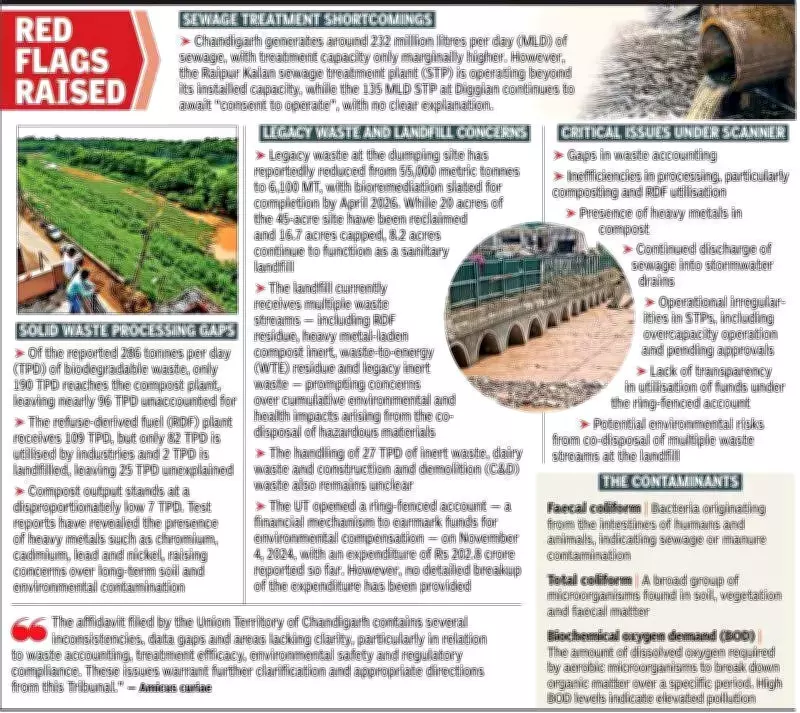
- Sewage Treatment Shortcomings: Chandigarh generates approximately 232 million litres per day of sewage, with treatment capacity only marginally higher. The Raipur Kalan sewage treatment plant is operating beyond its installed capacity, while the 135 MLD STP at Diggian continues to await consent to operate, with no clear explanation provided.
- Solid Waste Processing Gaps: Of the reported 286 tonnes per day of biodegradable waste, only 190 TPD reaches the compost plant, leaving nearly 96 TPD unaccounted for. The refuse-derived fuel plant receives 109 TPD, but only 82 TPD is utilized by industries and 2 TPD is landfilled, leaving 25 TPD unexplained. Compost output remains disproportionately low at 7 TPD, and test reports have detected heavy metals such as chromium, cadmium, lead, and nickel, raising concerns over long-term soil and environmental contamination.
- Legacy Waste and Landfill Concerns: Legacy waste at the dumping site has reportedly decreased from 55,000 metric tonnes to 6,100 MT, with bioremediation slated for completion by April 2026. While 20 acres of the 45-acre site have been reclaimed and 16.7 acres capped, 8.2 acres continue to function as a sanitary landfill. This landfill currently receives multiple waste streams, including RDF residue, heavy metal-laden compost inert, waste-to-energy residue, and legacy inert waste, prompting worries about cumulative environmental and health impacts from the co-disposal of hazardous materials. The handling of 27 TPD of inert waste, dairy waste, and construction and demolition waste also remains unclear.
Financial Transparency and Regulatory Oversight Issues
The UT administration opened a ring-fenced account on November 4, 2024, as a financial mechanism to earmark funds for environmental compensation, with an expenditure of Rs 202.8 crore reported so far. However, no detailed breakdown of this expenditure has been provided, further exacerbating concerns over transparency and accountability in environmental governance.
Critical Issues Under Scanner
The amicus curiae has emphasized several critical areas requiring immediate attention:

- Gaps in waste accounting and inefficiencies in processing, particularly composting and RDF utilization.
- The presence of heavy metals in compost and continued discharge of sewage into stormwater drains.
- Operational irregularities in sewage treatment plants, including overcapacity operation and pending approvals.
- Lack of transparency in the utilization of funds under the ring-fenced account.
- Potential environmental risks from the co-disposal of multiple waste streams at the landfill.
The amicus curiae stated, "The affidavit filed by the Union Territory of Chandigarh contains several inconsistencies, data gaps and areas lacking clarity, particularly in relation to waste accounting, treatment efficacy, environmental safety and regulatory compliance. These issues warrant further clarification and appropriate directions from this Tribunal."
Understanding the Contaminants
The pollutants identified in the stormwater drains include:
- Faecal Coliform: Bacteria originating from the intestines of humans and animals, indicating sewage or manure contamination.
- Total Coliform: A broad group of microorganisms found in soil, vegetation, and faecal matter.
- Biochemical Oxygen Demand: The amount of dissolved oxygen required by aerobic microorganisms to break down organic matter over a specific period. High BOD levels indicate elevated pollution.
These findings underscore significant public health risks and environmental degradation, calling for urgent remedial actions and stricter regulatory oversight in Chandigarh.