In a significant relief for residents, the air quality across the National Capital Region (NCR) showed marked improvement on Friday, moving out of the 'severe' and 'very poor' categories into the 'poor' zone after a prolonged spell of hazardous pollution. This positive shift prompted the Commission for Air Quality Management (CAQM) to lift the stringent restrictions imposed under Stage III of the Graded Response Action Plan (GRAP) with immediate effect.
AQI Shows Significant Drop Across NCR Cities
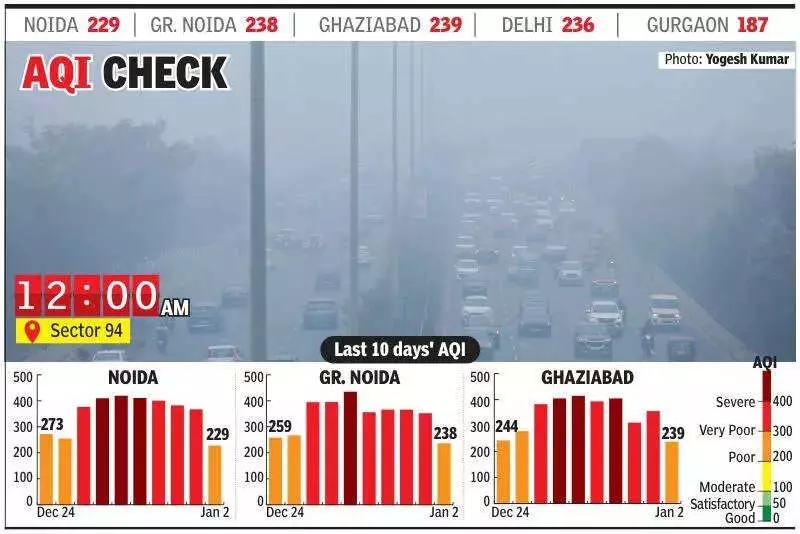
The air quality index (AQI) recorded a substantial decline in key cities of the NCR. In Noida, the AQI was measured at 229, a significant drop from 367 recorded just a day earlier. Similarly, Greater Noida saw its AQI fall to 238 from 352, while Ghaziabad's air quality improved to an AQI of 239 from 356 on the previous day.
The station-wise data provided a granular view of the improvement. In Noida, Sector 116 recorded an AQI of 240, Sector 1 at 234, and Sector 125 at 232, all remaining in the 'poor' category. Notably, Sector 62 entered the 'moderate' category with an AQI of 200. In Greater Noida, Knowledge Park V recorded 261 and Knowledge Park III recorded 216, both in the 'poor' range. Ghaziabad presented a mixed picture, with Vasundhara still in the 'very poor' category at 313, while Sanjay Nagar (224) and Loni (223) were 'poor', and Indirapuram was 'moderate' at 198.

CAQM Revokes Curbs, But Some Restrictions Remain
Responding to the improved conditions, the CAQM decided to revoke all actions under Stage III of GRAP across Delhi-NCR. These restrictions, which included a ban on most construction and demolition activities and the operation of BS-IV diesel and BS-III petrol vehicles in the region, had been in force for 20 days since December 13. However, the commission clarified that measures under Stages I and II of GRAP will continue. Furthermore, construction sites that were individually issued closure orders for specific violations cannot resume work without a fresh directive from the authorities.
The revocation means that construction work can resume and the affected vehicle categories can return to the roads in Delhi-NCR, providing a boost to economic activity.
Weather Patterns and Forecast: A Temporary Respite?
Meteorological factors played a crucial role in dispersing the accumulated pollutants. According to the Indian Institute of Tropical Meteorology (IITM), predominant surface winds blew from the northwest at speeds below 10 kmph during the afternoon, though they slowed to below 5 kmph in the evening. Delhi benefited from overnight winds averaging 12 kmph, which helped lift the fog and ventilate pollutants, leading to a visible improvement in visibility and air quality.
The forecast, however, suggests the improvement may be short-lived. For Saturday, the IMD predicts a mainly clear sky with shallow to moderate fog in the morning. Surface winds are expected from the west, remaining below 10 kmph in the morning, increasing to less than 15 kmph in the afternoon, and decreasing again at night. The IITM's early warning system indicates that the AQI is likely to remain in the 'poor' category on Saturday but may deteriorate back to 'very poor' from Sunday onwards.
Delhi's Parallel Recovery and Ongoing Alerts
Delhi mirrored the recovery seen in its NCR counterparts. The city's AQI at 4 PM was recorded at 236, a major improvement from 380 at the same time on Thursday. The minimum temperature also dipped to 9.1 degrees Celsius, over a degree lower than the previous day's 10.6 degrees.
Despite the improvement, the Met department has issued a yellow alert for Saturday and Sunday, forecasting dense fog in isolated areas alongside a further dip in minimum temperatures. The maximum temperature is expected to hover between 17-19 degrees Celsius. The fog and poor weather conditions continued to impact air travel, leading to the cancellation of 32 arrival and 34 departure flights at source or destination airports.
While the revocation of GRAP Stage-III brings temporary relief, authorities and citizens remain cautious as weather conditions conducive to pollution accumulation are predicted to return, potentially undoing the gains of the last 24 hours.