

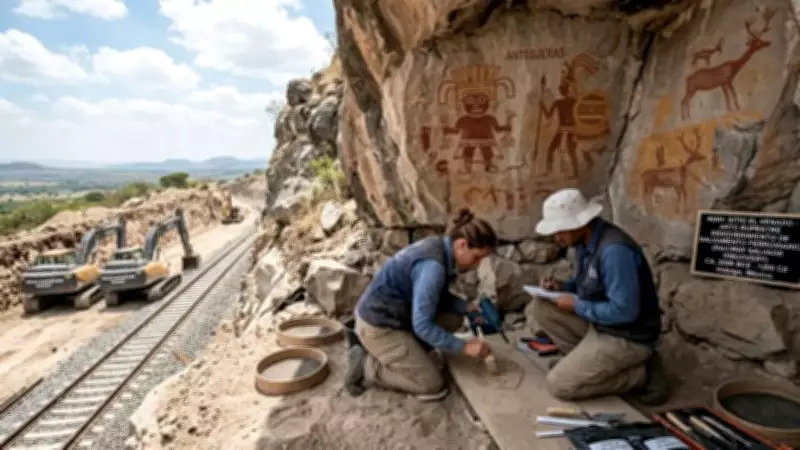
Railway Construction in Mexico Leads to Major Archaeological Discovery
Research conducted for the construction of the passenger railway connecting Mexico City and Querétaro has resulted in an extraordinary archaeological breakthrough. Archaeologists from the National Institute of Anthropology and History (INAH) have identified 16 newly discovered rock-art sites at El Venado in Hidalgo, providing unprecedented insights into the cultural evolution of the Tula region.
A Ceremonial Landscape Spanning Millennia
The sites constitute a ceremonial landscape that offers a chronological view of four thousand years of history. This timeline extends from the Archaic period hunter-gatherer groups, dating back to around 2000 BC, up to the time of the Postclassic Toltec Empire. The discovery was made possible through a mandatory salvage operation implemented for the railway project, allowing researchers to survey previously unreachable areas.
The rock art features complex petroglyphs (rock engravings) and pictographs (pigment-based art) representing various forms of gods, shields, and the rain god Tlaloc. Two primary techniques were documented: pointillism for engraving and the use of mineral pigments. Among the most significant figures identified are a warrior with a chimalli (a type of shield) and a figure with 'goggle-eyes' (anteojeras), which are diagnostic attributes of Tlaloc, the god of rain and fertility.

Government Intervention for Cultural Preservation
In a notable decision, the government of Mexico has officially altered the course of the railway to preserve these culturally significant sites. This action represents a unique occasion where cultural preservation has taken precedence over modern industrial expansion, highlighting the value placed on archaeological heritage.
Evidence of Long-Distance Cultural Exchange
One of the most unexpected aspects of the El Venado discovery is its artistic connection to the Mogollon iconographic tradition of the Southwestern United States and Northern Mexico. This finding suggests that the Tula region served as a center for long-distance cultural interactions or that common symbolism was transmitted throughout the 'Northern Frontier' of Mesoamerica before the emergence of the Aztec civilization.
Scientific Significance and Future Research
Published in the Journal of Archaeological Science: Reports, this discovery indicates that the El Venado site functioned as a sacred geography, where people used astronomical alignments to codify ritual cycles. The site's mineral pigments, pointillism techniques, and sacred geometry related to Tlaloc provide valuable new insights into ancient spiritual beliefs and daily life in the Tula River area.
This breakthrough demonstrates that ongoing archaeological surveys at unexcavated sites across Mexico can yield significant findings, enhancing our understanding of ancient cultures and their histories. The research underscores the importance of integrating archaeological assessments into modern development projects to uncover and protect invaluable cultural heritage.






