

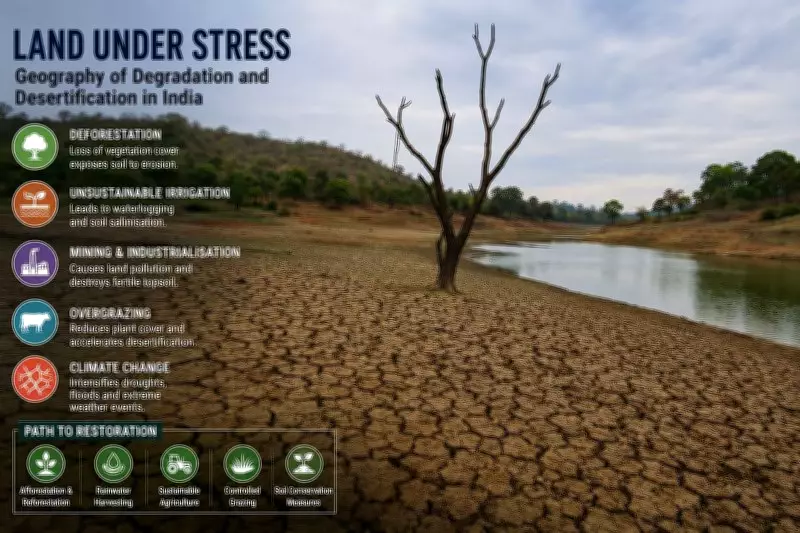
Land degradation and desertification are pressing environmental challenges in India, affecting agricultural productivity, biodiversity, and livelihoods. According to the latest data from the Indian Space Research Organisation (ISRO) and the Ministry of Environment, Forest and Climate Change, over 30% of India's geographical area is undergoing degradation. This article delves into the geography of this crisis, examining its causes, regional patterns, and implications.
Understanding Land Degradation and Desertification
Land degradation refers to the decline in land quality due to natural or human-induced processes, while desertification is a severe form of degradation in dryland areas. India's diverse geography, ranging from arid deserts to humid forests, makes it vulnerable to various degradation types, including soil erosion, salinization, and vegetation loss.
Key Drivers of Degradation
- Deforestation: Clearing forests for agriculture, urbanization, and infrastructure projects exposes soil to erosion.
- Overgrazing: Excessive livestock grazing in arid and semi-arid regions strips vegetation cover.
- Unsustainable Agriculture: Intensive farming, overuse of fertilizers, and improper irrigation lead to soil nutrient depletion and salinization.
- Climate Change: Erratic rainfall and rising temperatures exacerbate drought conditions and soil degradation.
Regional Patterns of Degradation
The extent and type of degradation vary across India's states and union territories. The ISRO's Desertification and Land Degradation Atlas (2021) provides a detailed spatial analysis.

High-Degradation Zones
States like Rajasthan, Gujarat, Maharashtra, and Karnataka have the highest proportion of degraded land. In Rajasthan, desertification affects over 70% of the area, driven by sand dune migration and water scarcity. Gujarat faces salinization in coastal areas due to over-extraction of groundwater.
Moderate and Low-Degradation Areas
In contrast, states like Kerala, Assam, and West Bengal have lower degradation levels, but hotspots exist due to shifting cultivation and tea plantation practices. The northeastern states face degradation from jhum cultivation (slash-and-burn agriculture).
Impacts of Land Degradation
Land degradation has far-reaching consequences:
- Agricultural Loss: Reduced soil fertility leads to lower crop yields, threatening food security.
- Economic Costs: The economic loss due to land degradation is estimated at 2% of India's GDP annually.
- Biodiversity Decline: Habitat loss endangers species and disrupts ecosystems.
- Livelihood Impacts: Millions of farmers and pastoralists depend on healthy land for their survival.
Government Initiatives and Policy Responses
India has committed to the United Nations Convention to Combat Desertification (UNCCD) and aims to restore 26 million hectares of degraded land by 2030. Key programs include:
- Pradhan Mantri Krishi Sinchayee Yojana (PMKSY): Focuses on water conservation and efficient irrigation.
- Soil Health Card Scheme: Provides farmers with information on soil nutrients to optimize fertilizer use.
- Integrated Watershed Management Programme (IWMP): Promotes sustainable land management practices.
- National Afforestation Programme: Aims to increase forest cover and prevent erosion.
Conclusion
Land degradation and desertification are critical issues that require urgent attention. By understanding the geography of these processes, policymakers can design targeted interventions. Sustainable land management practices, community participation, and technological innovations are essential to reverse the trend and ensure a resilient future for India's landscapes.






