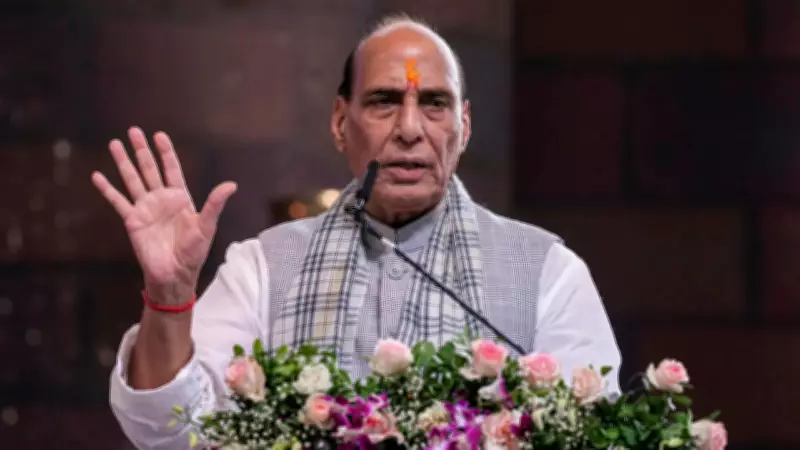
Defence Minister Rajnath Singh on Friday described India's indigenous Project Kusha air defence system as a potential game changer for the nation's security framework, noting its proven effectiveness during Operation Sindoor.
Rajnath Singh's Address at DRDL
Speaking at the inauguration of the Advanced Weapon System Complex at the Defence Research and Development Laboratory (DRDL) in Hyderabad, Singh drew a parallel between the system's protective capabilities and the legendary Govardhan Hill from Hindu mythology.
According to news agency ANI, Singh stated, "Today I predict that the Project Kusha will be a game changer for India's security scenario." Referring to Operation Sindoor—the tri-services military campaign launched in 2025 after the Pahalgam terror attack—he added, "It is a world-class indigenous air defence system, which has proved its importance during Operation Sindoor. No further proof is needed. Just as the Govardhan hill protected the entire region of Braj in the Dvapara Yuga, our air defence system provided a protective umbrella for the entire region during that period."

What is Project Kusha?
Project Kusha is a long-range indigenous surface-to-air missile (SAM) system developed by DRDO to provide layered air defence against various aerial threats. Designed to rival advanced platforms like Russia's S-400 Triumf, it features three interceptor variants:
- M1 interceptor: range of approximately 150 km
- M2 interceptor: range of approximately 250 km
- M3 interceptor: range of 350-400 km
The system is intended to counter fighter aircraft (including stealth platforms), drones, cruise missiles, precision-guided munitions, and certain ballistic missile threats. In 2023, the Defence Acquisition Council granted Acceptance of Necessity (AoN) for procuring five squadrons for the Indian Air Force. Operational deployment is expected around 2028-2030.
Integration with Broader Air Defence Plans
Project Kusha is expected to be integrated with the Indian Air Force's Integrated Air Command and Control System (IACCS), enabling real-time coordination between military and civilian radar networks. It is also linked to "Mission Sudarshan Chakra", an initiative aimed at building a multi-layered air and missile defence shield for India by 2035. The architecture will combine long-range systems like Kusha with Quick Reaction Surface-to-Air Missiles (QRSAM), Very Short-Range Air Defence Systems (VSHORADS), ballistic missile defence assets, and future directed-energy weapons.
Changing Nature of Warfare
Singh highlighted the increasingly uncertain global security environment, marked by conflicts, instability, and emerging wars reshaping international relations. "The international order is passing through a phase of tension and change. Old assumptions are breaking down, and new alliances and new challenges are taking shape," he said. He stressed the need for both resilience and deterrence, emphasizing that countries must absorb shocks while discouraging adversaries through strong defence capabilities. The minister noted that modern warfare is evolving rapidly with technologies like artificial intelligence, electronic warfare, and advanced sensors.
Push for Indigenous Defence Ecosystem
Singh stated that India's defence ecosystem is undergoing significant transformation, with DRDO laboratories, defence public sector undertakings, private industry, startups, MSMEs, and academia collaborating more closely than ever. "DRDO laboratories, defence public sector undertakings, private industries, startups, MSMEs, and academia are working together with greater integration than ever before," he said. He expressed confidence that this collaborative model would accelerate India's journey from innovation to production and operational capability. He added that programmes like Project Kusha and institutions like DRDL strengthen public confidence by ensuring India remains prepared in an increasingly volatile global security landscape.