Khejri Tree Protection Movement Sweeps Across Rajasthan Amid Solar Expansion Concerns
In the arid landscapes of Rajasthan's desert districts, a single tree species has ignited a massive statewide protest movement that has brought together communities, political rivals, and religious leaders in an unprecedented show of environmental solidarity. The Khejri tree, scientifically known as Prosopis cineraria and designated as Rajasthan's official state tree, has become the focal point of what is now being called the 'Khejri Bachao Andolan' - a Save Khejri Movement that has transcended local boundaries to become a major political and environmental issue.
Protests Escalate Across Multiple Districts
The current phase of agitation intensified dramatically in early February when more than 360 saints and local residents initiated a hunger strike in Bikaner, demanding an immediate and complete ban on the cutting of khejri trees for solar power projects. The protest site has shifted from the Polytechnic College ground near the Collectorate to the Bishnoi Dharamshala, where hunger strikers continue their demonstration despite deteriorating health conditions.
Four protesters have been hospitalized at Prince Bijay Singh Memorial Hospital, with several others receiving medical assistance at camps established near the protest site. Mokhram Dharaniya, one of the hospitalized activists, declared: "People are sitting on a hunger strike, including me. Our protest will continue until our demands are met."

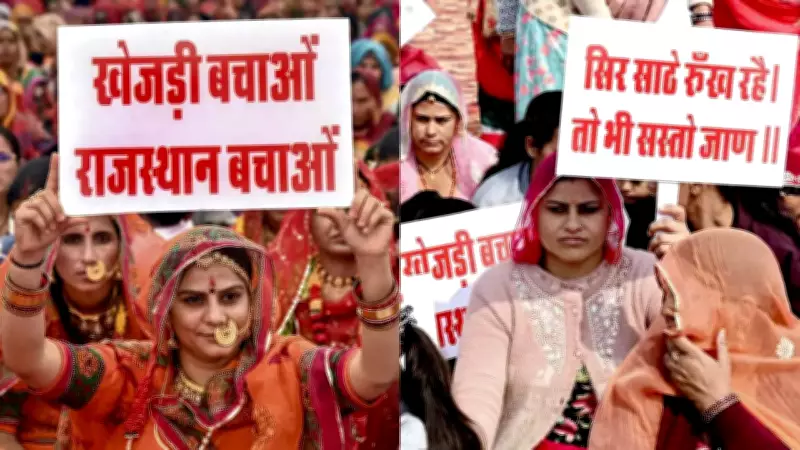
The movement has witnessed remarkable participation, with markets shutting down for hours, government and private schools observing half-day holidays in solidarity, and thousands gathering at protest sites. Organizers reported arranging food for nearly one lakh participants, with hundreds of volunteers managing logistics. Police have deployed additional forces, erected barricades, and kept water cannons on standby, though the protests have remained peaceful despite the scale and tensions.
Political Convergence and Historical Echoes
The movement has produced a rare moment of political convergence, drawing support across party lines. Chief Minister Bhajan Lal Sharma has termed the khejri tree as Rajasthan's "Kalpavriksha" - a wish-fulfilling tree in Indian tradition - and announced that his government is drafting conservation legislation. However, protesters have rejected partial measures, demanding a comprehensive statewide ban.
Former Chief Minister Ashok Gehlot expressed strong support for the movement, describing the indiscriminate cutting of khejri trees as "extremely painful and unacceptable." In a politically significant development, former Chief Minister Vasundhara Raje publicly backed the movement, sharing photographs of herself worshipping a khejri tree and pledging cross-party support for its protection.
The protests have deep historical resonance, repeatedly invoking the 1730 Khejarli massacre where 363 members of the Bishnoi community, led by Amrita Devi Bishnoi, sacrificed their lives to prevent the felling of khejri trees. Protesters carry posters featuring the revered Bishnoi proverb: "Sir saanthe rukh rahe to bhi sasto jaan" (If a tree can be saved, even at the cost of one's head, consider it a bargain).
Solar Expansion Versus Ecological Protection
At the heart of the agitation are allegations that large numbers of khejri trees have been cut to facilitate solar power projects in western Rajasthan, which has emerged as a hub for renewable energy development. While solar expansion is central to India's energy transition goals, protesters argue that implementation has come at the cost of ecologically vital trees that form the backbone of desert ecosystems.
The khejri tree possesses unique ecological significance:

- Deep root systems that access groundwater and survive prolonged drought
- Nitrogen-fixing properties that improve soil fertility
- Stabilization of sand dunes to reduce desertification
- Provision of fodder (leaves called "loong"), food (pods called "sangri"), fuel, and traditional medicine
Environmental activist Parasram Bishnoi, founder of the Khejri Bachao Andolan, stated: "Large tracts of desert land are being indiscriminately handed over to solar parks, destroying the local ecosystem. Without legal protection, the desert's survival is at stake."
Legal Framework and Movement Demands
Protesters argue that existing legal protections for khejri trees are inadequate and inconsistently enforced. Former Luni MLA Mahendra Vishnoi noted: "Confusion exists in current laws concerning khejri conservation. The penalties must be precise and severe. Without a fear of the law, this destruction will persist."
The movement's key demands include:
- A comprehensive statewide ban on khejri tree felling
- Specific legislation making tree cutting a punishable offense
- Provisions for fines up to Rs 1 lakh for violations
- Temporary protection until permanent legislation is enacted
The agitation has spread beyond Bikaner to multiple districts including Barmer, Jaisalmer, Jodhpur, Pali, Jalore, Phalodi, Sriganganagar, and Churu. In Barmer, protesters gathered at the Collectorate, with some youths climbing gates and raising slogans after police closed the premises.
Personal Sacrifices and Broader Implications
The movement has taken deeply personal dimensions. Following the death of environmental activist Radheshyam Bishnoi in a road accident last year, his mother Ratni Devi and wife Nirma Bishnoi have continued his work and are now participating in hunger strikes demanding khejri protection.
As the Khejri Bachao Andolan enters its sixth day, the standoff continues between protesters demanding immediate written assurances and the state government's promise of forthcoming legislation. The movement represents a critical test case for balancing renewable energy development with ecological conservation in one of India's most fragile landscapes, with the khejri tree standing at the intersection of ecology, economy, and cultural identity in Rajasthan.