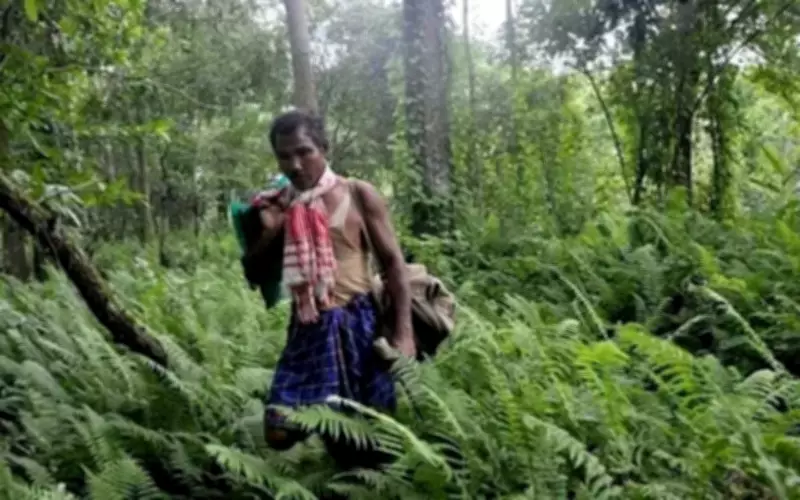
The Lone Planter Who Created a Forest
Long before climate action became a global movement, a teenager in Assam was already practicing it amidst the dust, heat, and floodwaters of the Brahmaputra River. What he witnessed that day was not merely an empty stretch of land, but a fragile ecosystem silently collapsing under the relentless sun. In 1979, Jadav Payeng encountered a desolate sandbar where floods had left dead reptiles exposed, and he began planting bamboo and saplings there entirely on his own. What started as a small act of rescue gradually evolved into Molai Forest, now celebrated as one of India's most extraordinary conservation narratives.
A Sandbar That Refused to Remain Barren
The power of Payeng's story lies in its immense scale and unwavering patience. He did not arrive with a formal campaign, financial grants, or a grand master plan. According to his own longstanding account, he simply continued planting and nurturing trees year after year, transforming a barren sandbar into what is now known as Molai Forest. Today, this forest covers approximately 550 hectares, equivalent to around 1,360 acres. Additionally, separate government records highlight his broader contributions to plantation efforts across nearly 300 hectares on Majuli Island.
Payeng's initial motivation stemmed from profound grief. The sight of animals stranded and perishing on open land compelled him to envision shade where none existed. This emotional origin is crucial because it clarifies why his story has resonated far beyond Assam's borders. It is not merely a tale of tree-planting; it is a narrative about one individual's refusal to accept that damaged land must remain damaged indefinitely.

One Tree at a Time, Over Decades
The forest did not emerge by chance. It materialized through relentless repetition: planting, watering, protecting, and returning consistently. Historical profiles describe how Payeng commenced with bamboo seeds and saplings, then persistently carried water, collected seeds, and leveraged local knowledge to ensure the plants' survival. Gradually, the sandbar underwent a remarkable transformation. What was once barren began to develop its own microclimate, vegetative cover, and inherent resilience.
This aspect of the story is often overlooked. Payeng's achievement was not solely about placing trees in the ground; it was about sustaining them through floods, extreme heat, and general neglect. The distinction between a plantation and a forest extends beyond density to encompass endurance. His labor became a profound lesson in what patient stewardship can accomplish when practiced persistently enough to reshape the landscape itself.
When the Nation Finally Took Notice
For many years, his work remained largely unnoticed outside the local region. According to a 2014 correspondence in Current Science regarding Payeng, the Assam Forest Department only became aware of the forest in 2008, when elephants wandered into the area. By that time, the woodland had already established its own ecosystem, supporting deer, rabbits, birds, and various other wildlife, garnering attention as a self-created habitat on river land that had once seemed irreparable.
National recognition soon followed. A photograph in the presidential archive documents that Jadav Payeng received the Padma Shri on April 8, 2015. In 2021, the Prime Minister also referenced him in a public address as an individual who had actively contributed to plantations on Majuli and continued to advocate for forest conservation and biodiversity. Furthermore, Britannica now includes him among India's notable conservationists, cementing his legacy.
Why His Story Remains Urgent Today
Payeng's appeal transcends mere inspiration. His life poses a more challenging question: what does conservation resemble when it lacks institutional funding, polish, or amplification? In his instance, it manifested as daily labor, reliance on local knowledge, and a steadfast commitment to persevere even when no one was observing. This is why his narrative resonates so powerfully in an era of climate anxiety. It demonstrates that restoration is not always an abstract concept; sometimes, it originates with one person, one patch of land, and one decision to never surrender.

The deeper significance of Jadav Payeng's life is not that one man became a legend. It is that he transformed consistency into climate action long before the term gained popularity. He illustrated that restoration can commence in the most modest manner possible and that the most compelling environmental argument is often inscribed in roots, shade, and survival. In a world obsessed with rapid outcomes, Payeng's forest symbolizes something far rarer: faith extended across decades.