

India's Carbon Emissions See Historic Decline in 2025
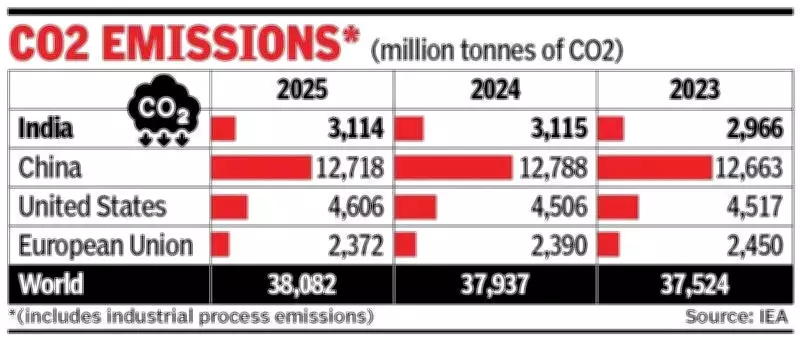
In a significant environmental milestone, India's carbon emissions have paused their upward trajectory, with a slight decrease recorded in 2025. This marks the first instance in decades where emissions have fallen under normal economic conditions, breaking a persistent trend of steady increases.
Cyclical and Structural Drivers Behind the Drop
The decline was primarily driven by a combination of cyclical weather patterns and ongoing structural shifts in energy production. Unlike previous reductions, which occurred only during major disruptions like the 2020 pandemic or 1970s oil shocks, this drop happened amidst regular economic activity.
A powerful and prolonged monsoon in 2025 played a crucial role. The early arrival of heavy rains and cooler temperatures significantly reduced electricity demand. Key factors included decreased need for air conditioning and agricultural water pumping, which are among the largest loads on the power grid. As a result, power consumption growth slowed to just 1.4% in 2025, down from over 6% in the preceding four years.

According to estimates from the International Energy Agency, cooling degree days were 10% lower than in 2024, further suppressing energy use. This softness in demand directly impacted coal-fired generation, which fell by approximately 3%—only the third such decline in half a century. Weather conditions alone are estimated to have reduced coal demand by about 8 million tonnes of coal equivalent, cutting more than 20 million tonnes of CO₂ emissions.
Renewable Energy Expansion Accelerates
Simultaneously, India's energy supply grew cleaner. The generous monsoon boosted hydropower output, while renewable capacity expanded rapidly. In 2025, India added nearly 50 gigawatts of solar capacity, pushing total renewable additions up by about 60%, the fastest pace among major economies. Wind installations also doubled to more than 6 gigawatts.
With subdued demand and increased clean generation, natural gas use fell by 3.5%, including a nearly 10% drop in gas-fired power. This shift underscores a broader transition towards sustainable energy sources, contributing to the overall emission reduction.
Global Emission Trends in Contrast
Elsewhere in the world, emission patterns varied. In the United States, a cold winter and higher gas prices led to a switch back to coal, nudging emissions upward. Europe's emissions continued to decline, though at a slower rate, due to weaker wind and hydro output coinciding with stronger heating demand.
China managed a modest decline of around 0.5%, driven by rapid additions of renewables and nuclear power displacing coal in electricity generation. Globally, an unusual pattern emerged: for the first time in nearly three decades, emissions in advanced economies grew faster than in emerging ones, with a 0.5% rise in the former compared to a 0.3% growth in the latter.
This development highlights the complex interplay of weather, economic conditions, and energy policies in shaping carbon footprints worldwide. India's progress, while influenced by temporary factors, also reflects sustained investments in renewable infrastructure, offering a hopeful sign for future climate efforts.






