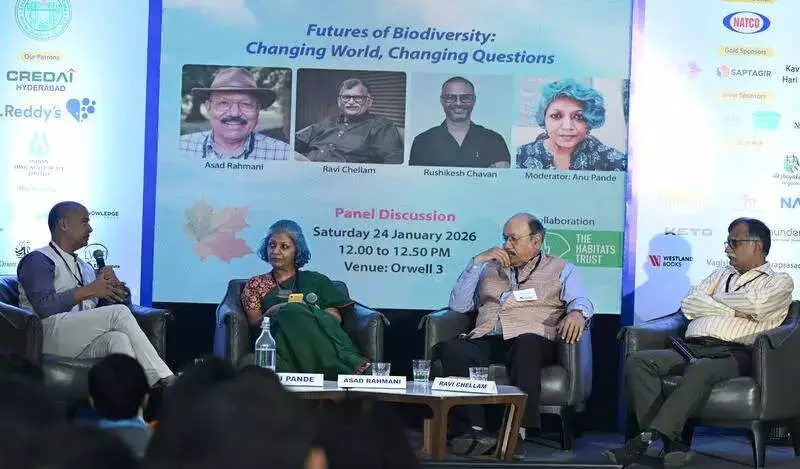
Hyderabad Literary Festival Sounds Alarm on India's Narrow Conservation Approach
At the Hyderabad Literary Festival on Saturday, environmental experts delivered a stark warning: India's conservation discourse remains disproportionately focused on large mammals and charismatic bird species, while ecosystems across the country face rapid and potentially irreversible degradation. This critical perspective emerged during discussions that highlighted the urgent need for a broader, more inclusive approach to environmental protection.
Habitat Erosion: The Silent Crisis
Speakers emphasized that unchecked urbanization and relentless infrastructure expansion are systematically erasing natural habitats throughout India. From fragile coastlines and vibrant coral reefs to serene lakes, dense forests, expansive grasslands, and even urban tree cover, multiple ecosystems are disappearing at an alarming rate. This widespread habitat loss is pushing numerous species toward decline and potential extinction, creating a biodiversity crisis that extends far beyond individual animal populations.
"We keep talking about saving individual species, but rarely about saving habitats. Without habitats, conservation has no meaning," asserted conservationist Rushikesh Chavan from the Habitats Trust. His statement underscored a fundamental flaw in current conservation strategies that prioritize charismatic fauna over the ecosystems that sustain them.

Development Versus Sustainability: A Critical Balance
Chavan directly linked development goals with environmental costs, cautioning against short-term economic thinking that sacrifices long-term ecological health. "If we truly want a Viksit Bharat, we cannot prioritise short-term profits over long-term sustainability," he declared, highlighting the contradiction between development aspirations and environmental stewardship.
The conservationist also flagged alarming changes occurring in marine ecosystems, particularly noting the devastating impact of rising water temperatures on coral reefs. "Coral reefs lost their colour due to rising water temperatures. In places like Lakshadweep, algae took over, sharks disappeared, turtles were gone, and corals are dying," he reported, painting a grim picture of marine biodiversity collapse.
Overlooked Ecosystems: Grasslands and Deserts in Peril
Ornithologist and conservation biologist Asad Rahmani reinforced these concerns by identifying several habitats already in deep trouble. "India's biodiversity hotspots are under immense pressure. Grasslands and deserts are among the most threatened ecosystems, yet they receive the least attention," he revealed, emphasizing that conservation efforts must extend beyond the traditional focus on forests and national parks.
Rahmani advocated for diverse protection models to address this complex challenge. "We need a mix of national parks, community reserves, and landscape-level conservation. While private protected areas are not ideal, in some parts of the world they worked," he suggested, proposing a flexible, multi-pronged approach to ecosystem preservation.
The Critical Role of Public Participation
Highlighting the essential role of public involvement, Rahmani added that conservation cannot succeed without broad societal support. "If people cannot contribute time, they can help through funding. Nearly 90% of conservation support comes from small and large donations; public involvement is critical," he explained, pointing to the financial realities of environmental protection efforts.
The discussions at the Hyderabad Literary Festival collectively painted a picture of a conservation paradigm in need of significant expansion. By shifting focus from individual species to entire habitats, balancing development with sustainability, protecting overlooked ecosystems, and engaging the public more effectively, India might address the environmental challenges threatening its natural heritage.