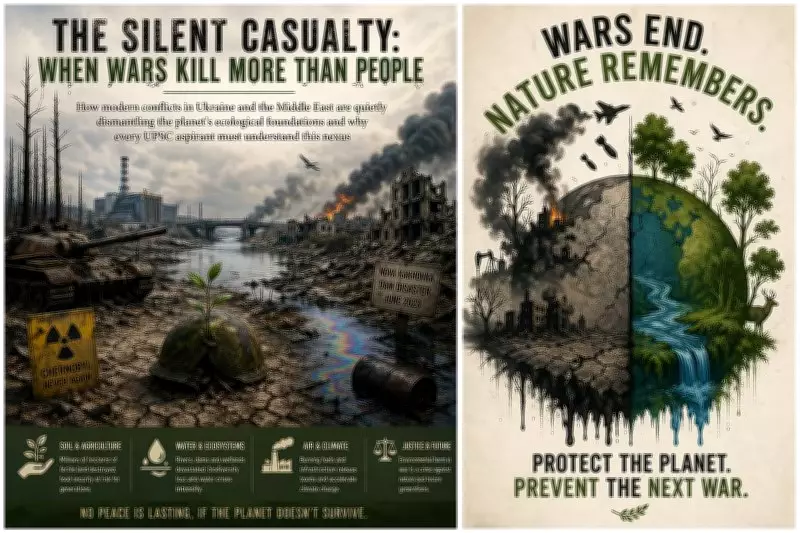
When the world debates war, it counts the dead, measures the displaced and tallies the ruins of cities. What it rarely counts is the rivers choked with oil, the forests turned to ash, the aquifers poisoned for generations. The environment does not bleed visibly. It does not appear in casualty reports. Yet in every modern conflict, it is among the first to fall and the last to recover.
The Hidden Cost of Modern Warfare
Conflicts in Ukraine and the Middle East have revealed a grim reality: war's ecological toll is staggering. In Ukraine, bombing of industrial sites has released toxic chemicals into the air and water. The destruction of the Kakhovka Dam in 2023 flooded vast areas, displacing wildlife and contaminating soil. In Gaza, Israeli airstrikes have damaged sewage and water infrastructure, leading to untreated waste flowing into the Mediterranean. These are not isolated incidents but part of a broader pattern.
Environmental Degradation as a Weapon
Warfare increasingly targets environmental resources. Water sources are deliberately polluted, forests are burned to deny cover, and oil wells are set ablaze. The 1991 Gulf War saw Kuwait's oil fields burning for months, releasing millions of tons of carbon dioxide. In Syria, the Islamic State's destruction of oil infrastructure caused long-term damage to the ecosystem. Such tactics not only harm the immediate environment but also contribute to climate change.

The Nexus of Conflict and Climate
Military activities are a major source of greenhouse gas emissions. The global military sector accounts for an estimated 5.5% of global emissions, more than the aviation and shipping industries combined. In conflict zones, emissions from tanks, aircraft, and explosions add to the carbon footprint. Moreover, the destruction of forests and wetlands reduces the planet's capacity to absorb carbon, creating a vicious cycle.
Long-Term Consequences for Human Health
Environmental damage from war has dire health impacts. Contaminated water leads to cholera and other diseases. Polluted air causes respiratory illnesses. Unexploded ordnance and landmines render land unusable for agriculture, leading to food insecurity. In Gaza, the collapse of waste management has led to outbreaks of disease. In Ukraine, soil contamination from heavy metals may affect crops for years.
Why UPSC Aspirants Must Understand This Nexus
The UPSC syllabus increasingly emphasizes contemporary global issues and their interlinkages. Understanding the war-environment nexus is crucial for essays, general studies, and interviews. It touches on topics like international relations, environmental policy, and human security. Moreover, India faces its own conflicts, such as in Kashmir and the Northeast, where environmental degradation is a concern. A holistic perspective on war's true cost is essential for future civil servants.
What Can Be Done?
International law, such as the Geneva Conventions, prohibits wanton destruction of the environment. However, enforcement is weak. Strengthening the Rome Statute of the International Criminal Court to include ecocide as a crime could be a step forward. Additionally, post-conflict environmental remediation must be prioritized. The UN Environment Programme has called for environmental assessments in conflict zones. Civil society and media must also highlight these issues.
The environment is the silent casualty of war. It does not scream, but it suffers silently. As future policymakers, UPSC aspirants must recognize that true peace is not merely the absence of war but the presence of a healthy, sustainable planet. The cost of conflict extends far beyond human lives; it threatens the very foundations of life on Earth.