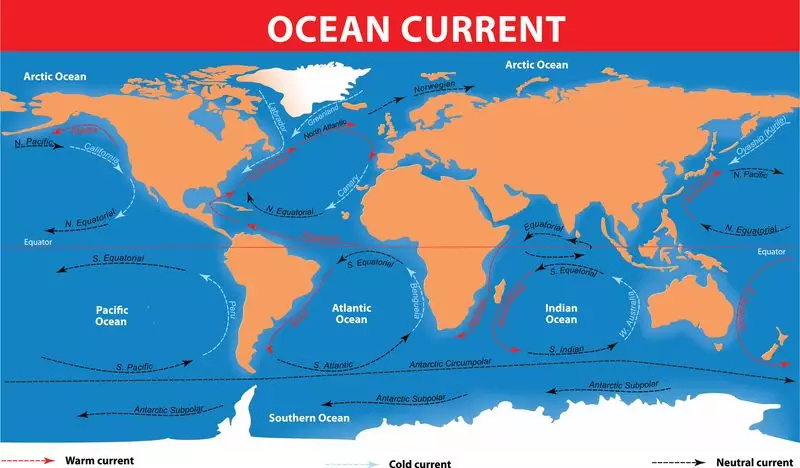
The vast blue expanse of our planet's oceans is far from still. Beneath the surface, a complex network of massive, moving rivers of water—known as ocean currents—ceaselessly circulates, acting as Earth's primary climate regulator. These invisible highways transport immense amounts of heat, nutrients, and moisture around the globe, directly influencing weather patterns, marine ecosystems, and the very habitability of continents. For a country like India, understanding these currents is key to deciphering the mysteries of the monsoon and anticipating the impacts of a changing climate.
The Engine Room of Global Climate
Ocean currents are primarily set in motion by two fundamental forces: the Sun and Earth's rotation. The Sun's uneven heating creates temperature and salinity differences, leading to variations in water density. Warm, less dense water moves from the equator towards the poles, while cold, denser water sinks and flows back towards the equator. This thermohaline circulation, driven by temperature ('thermo') and salt ('haline'), is the deep-ocean component of a global system often called the 'global conveyor belt.'
Simultaneously, Earth's rotation deflects moving air and water through the Coriolis effect, giving major currents their characteristic clockwise spirals in the Northern Hemisphere and counter-clockwise spirals in the Southern Hemisphere. Surface currents are also powerfully shaped by prevailing wind patterns like the trade winds and the westerlies.
Direct Impact on the Indian Subcontinent
The influence of these oceanic movements on India is profound and immediate. The most significant phenomenon is the Indian Monsoon, a lifeblood for agriculture and water resources. The seasonal reversal of winds is intimately linked to the differential heating of the Indian landmass and the surrounding Indian Ocean. Currents like the Somali Current along the coast of East Africa play a crucial role in this dance.
During the summer monsoon, the moisture-laden southwesterly winds cross the warm equatorial currents, picking up immense amounts of water vapor which is then dumped as rainfall over the subcontinent. Any alteration in sea surface temperatures, such as the warming during an El Niño event in the Pacific, can disrupt this delicate balance, leading to weak monsoons and droughts. Conversely, a La Niña or a positive Indian Ocean Dipole can enhance rainfall.
A Delicate System Under Threat
The stability of this global circulatory system is now facing unprecedented stress from human-induced climate change. The accelerated melting of polar ice caps, particularly in Greenland and Antarctica, is injecting vast quantities of freshwater into the oceans. This freshwater influx can lower the salinity and density of seawater in critical sinking regions, potentially slowing down or even disrupting the thermohaline conveyor belt.
The consequences of such a slowdown would be catastrophic and global, but would have specific ramifications for India:
- Monsoon Disruption: Changes in ocean heat transport could fundamentally alter the timing, intensity, and distribution of the monsoon rains.
- Extreme Weather: Increased frequency and severity of cyclones in the Bay of Bengal and the Arabian Sea.
- Sea Level Rise: Not uniform; changes in currents can lead to a higher-than-average sea level rise along the Indian coastline.
- Marine Ecosystems: Shifts in nutrient-rich upwelling zones could collapse fisheries, affecting food security and livelihoods.
Furthermore, oceans have been absorbing about 90% of the excess heat trapped by greenhouse gases and 30% of anthropogenic carbon dioxide, leading to ocean warming and acidification. This stresses coral reefs (like those in the Andaman and Lakshadweep) and marine life, further destabilizing the ecological balance.
Why This Matters for Policy and Future
For aspirants of the Union Public Service Commission (UPSC) and for policymakers, a deep grasp of oceanography is no longer a niche subject but a necessity. The intricate link between ocean currents, climate change, and India's economic and food security is undeniable. Accurate long-range forecasting of monsoons, planning for coastal infrastructure, managing fisheries, and formulating international climate agreements all hinge on understanding these aquatic highways.
In conclusion, the silent, unseen journeys of ocean currents are fundamental to life as we know it. They are the beating heart of Earth's climate system. As we stand at the crossroads of a planetary climate shift, recognizing their role, monitoring their health, and mitigating the human activities that threaten their stability is perhaps one of the most critical challenges for India and the world in the 21st century. The need for robust scientific research and informed climate action has never been more urgent.