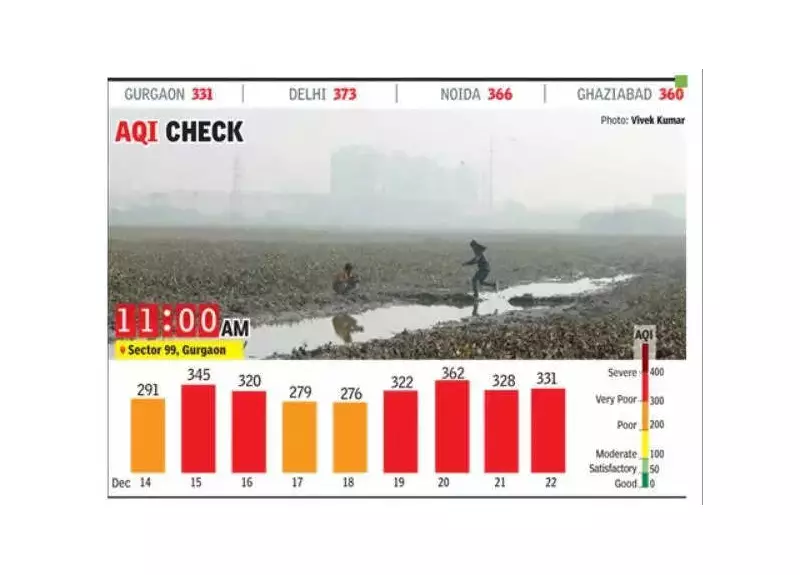
For the fourth day in a row, Gurgaon residents woke up to hazardous air on Monday, with the city's air quality index (AQI) firmly stuck in the 'very poor' zone. Official data recorded the city's average AQI at 331, a level that poses significant respiratory health risks, especially for vulnerable groups.
Residents Struggle as Pollution Invades Homes
The grim reality of the pollution crisis is being felt indoors and outdoors. "Opening windows is no longer an option," said Anil Mehta, a resident of Sector 43, highlighting the pervasive nature of the problem. "We wake up to a layer of dust on balconies and window sills every morning." Many living near busy roads reported that the toxic air is severely affecting daily life even inside their homes.
Data from the city's operational monitoring stations painted a consistently bleak picture. Sector 51 reported the worst air quality with an AQI of 346, followed by Teri Gram at 329. The NISE Gwal Pahari station also recorded 'very poor' air with an AQI of 317. The primary pollutant across all locations was fine particulate matter, known as PM2.5.

Weather Conditions Trap Pollutants, No Relief in Sight
According to the air quality forecasting body, the Decision Support System (DSS), the current meteorological conditions are preventing any dispersal of the accumulated pollutants. Calm winds, shallow to moderate fog, and a low mixing height are creating a lid over the region, trapping emissions close to the ground.
The DSS forecast offers little hope, stating that with the ventilation index remaining unfavourable, air quality is likely to stay in the 'very poor' category for the next six days. This indicates a prolonged winter pollution episode rather than a short-term spike.
Health Warnings and a Look at the Broader Region
Health experts have reiterated the serious consequences of prolonged exposure to such polluted air. As per Central Pollution Control Board guidelines, 'very poor' air can cause respiratory illness and breathing discomfort for most people on prolonged exposure.
Gurgaon's pollution woes are part of a larger regional crisis. Neighbouring Delhi also remained in the 'very poor' range, with a 24-hour average AQI of 373 at 4 pm on Monday. The low visibility, dipping to 150 metres at Palam, disrupted travel, causing delays to over 500 flights and several trains. While a weakening western disturbance might improve visibility slightly by December 26, air quality is expected to remain critically poor.