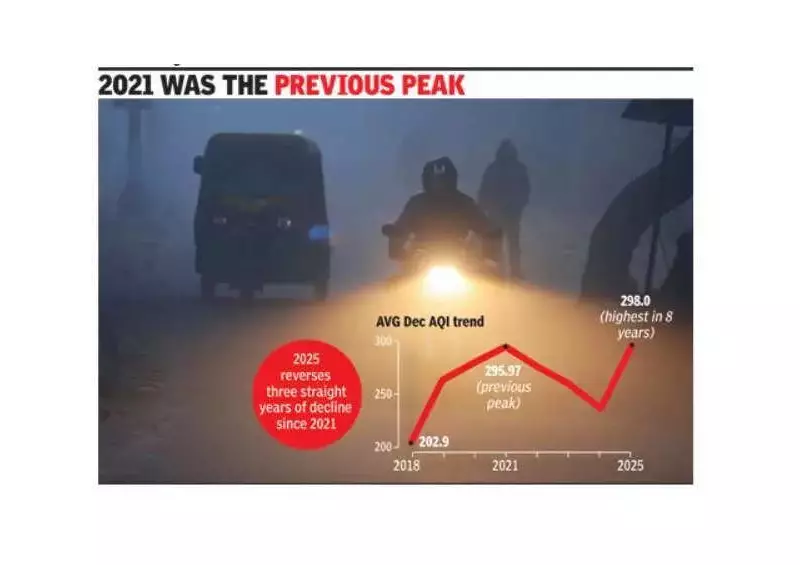
Gurgaon has recorded its most polluted December in at least eight years, marking a severe reversal in air quality trends and raising fresh alarms for residents and authorities. The city's average Air Quality Index (AQI) for December 2025 touched 298, entering the 'poor' category and setting a new peak for the month since 2018.
A Record-Breaking Spike in Pollution Levels
The data reveals a sharp deterioration from December 2024, when the average AQI was 236. The 2025 average of 298 has now surpassed the previous December peak of 295.9 recorded in 2021. This spike effectively erases the gains made in the intervening years, where averages had shown a declining trend: 276.6 in 2022 and 259.9 in 2023.
The situation was grim throughout the month, with Gurgaon failing to record a single day with 'moderate' air quality. Most days remained in the 'poor' or 'very poor' categories. Alarmingly, on at least 13 days, the AQI breached the 300 mark, signifying 'very poor' conditions hazardous to health.

The most critical phase occurred between December 18 and 22, when the AQI ranged from 322 to 364. Individual station readings were equally concerning, with the AQI touching 353 on December 28, 318 on December 29, and 326 on December 31.
Expert Analysis: Why Gurgaon's Air Turned Toxic
Environmental analysts point to a dangerous cocktail of meteorological factors and persistent local emissions. Manoj Kumar, an analyst at the Centre for Research on Energy and Clean Air (CREA), provided a stark assessment. Analysis of CPCB data shows Gurgaon emerged among the worst-polluted cities in the National Capital Region (NCR) in 2025.
"Gurgaon's annual average PM2.5 concentration is hovering close to 80 micrograms per cubic metre (µg/m³)," Kumar stated. This is nearly double India's national safe limit of 40 µg/m³ and a staggering sixteen times higher than the World Health Organization's guideline of 5 µg/m³.
Kumar explained the winter phenomenon: "Winters in north India trap pollutants close to the surface due to low mixing height, weak winds, and frequent fog. When this combines with steady local emissions from vehicles, industries, waste burning, and dust, the baseline air quality worsens. What we are seeing is a higher concentration build-up than last year."
Official Concerns and Stubborn Pollution Sources
Officials from the Haryana State Pollution Control Board (HSPCB) echoed these concerns, identifying specific local contributors. A senior official highlighted that Gurgaon's winter air remains a significant challenge, with dust and vehicular emissions acting as major culprits.
"Suspended road dust continues to play a significant role. Construction activities and damaged road stretches worsen the resuspension of dust particles," the official said. The warning was clear: "Unless emission control is strengthened across sectors, winter pollution will remain stubborn."
On numerous days, all four air quality monitoring stations in the city reported uniformly 'poor' to 'very poor' air, with spikes directly linked to calmer wind conditions that prevented the dispersal of pollutants.
For Gurgaon's residents, the data translates to a stark reality: almost the entire month was spent breathing air deemed unhealthy. The city was not alone in its plight, as neighbouring NCR cities, including Delhi, also endured most days in the 'very poor' category this winter. The reversal of positive trends from 2022-2024 underscores the persistent and escalating nature of the urban air pollution crisis in the region.