

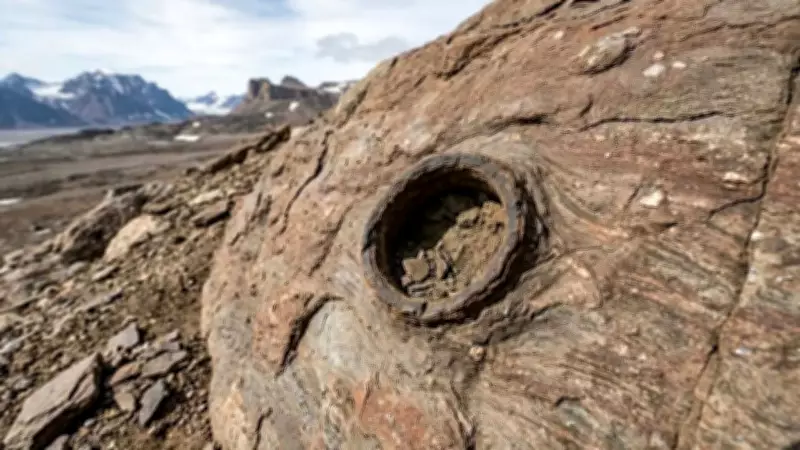
Ancient Greenland Lungfish Burrows Reveal Triassic Climate Secrets
Located in East Greenland's Fleming Fjord Formation, the recently identified 210-million-year-old lungfish burrows offer a profound glimpse into the volatile nature of the Late Triassic climate across ancient Greenland. These fossilized burrows indicate that lungfish employed a strategic survival tactic, digging into mud to endure seasonal droughts through a biological process known as aestivation, where they entered a dormant state until environmental conditions improved.
Trace Fossils Document Survival Behavior
Researchers have uncovered trace fossils—cylindrical structures created by lungfish—within sedimentary layers deposited in ancient lake basins due to geological processes in the Fleming Fjord Formation. Unlike body fossils that capture an organism's form, these burrows record actual behavior, specifically the act of burrowing into the substrate around 210 million years ago to escape dehydration. This discovery provides evidence that Triassic lungfish were capable of entering dormancy as a method to cope with harsh environmental conditions.
Insights into Pangaean Megamonsoonal Cycles
The physiological response of aestivation enabled lungfish to survive in intermittent lakes, which were subject to drying out due to Pangaean megamonsoonal cycles. According to the Geological Survey of Denmark and Greenland (GEUS) Bulletin, the strata containing these burrow holes consist of mudstones and siltstones that preserved cavity shapes from the time of mud deposition until hardening. These formations are crucial for understanding continental drift and Greenland's position on Earth during this period.

Reshaping Triassic Climate Models
Furthermore, these tiny holes serve as climate proxies, indicating significant fluctuations in precipitation at high amplitudes. Data published in research on NCBI reveals that high-latitude regions during the Triassic were substantially warmer and drier than previous models suggested. This challenges existing projections about past atmospheric and climatic conditions, highlighting the environmental stress—rather than lush ecosystems—that defined these ecosystems in the Late Triassic.
Geological and Palaeontological Significance
Geologists and palaeontologists are reconstructing the ancient world from these burrows, where animals retreated to survive beneath the earth's surface. This research, published on ResearchGate, enhances our understanding of Norian-Rhaetian transitional periods, emphasizing how environmental pressures shaped life during the Late Triassic. The findings underscore the importance of trace fossils in revealing behavioral adaptations and climatic histories, offering a new perspective on prehistoric survival strategies.






