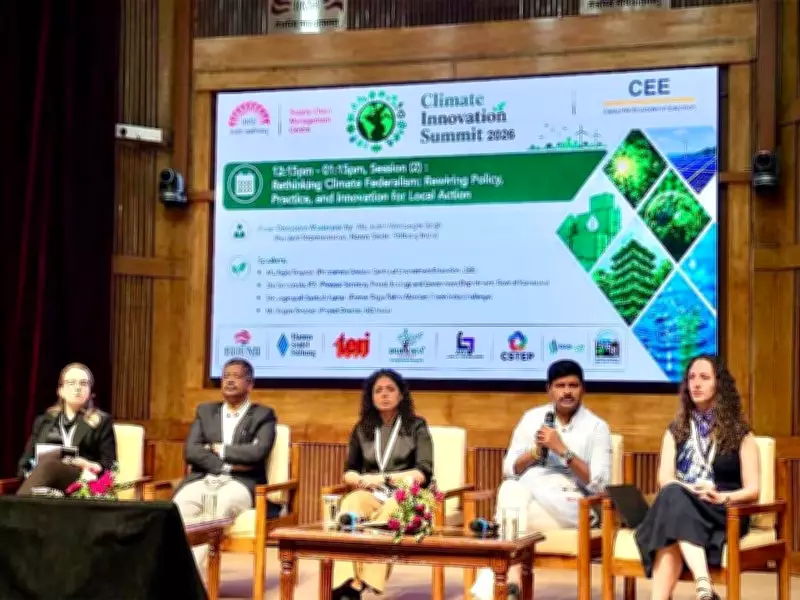
The Green India Challenge has emerged as a pioneering initiative, showcasing a citizen-led climate federalism model at the prestigious IIM Bangalore Climate Innovation Summit 2026. This summit, held on the sprawling campus of the Indian Institute of Management Bangalore, brought together environmentalists, policymakers, and citizens to discuss innovative approaches to combating climate change.
A New Paradigm in Climate Action
The Green India Challenge, founded by Parliamentarian Joginapally Santosh Kumar, emphasizes the power of individual and community participation in environmental conservation. Unlike top-down government programs, this initiative encourages citizens to take ownership of climate action, fostering a sense of responsibility and collective effort. The model presented at the summit demonstrates how decentralized, citizen-led efforts can complement national policies and accelerate progress toward sustainability goals.
Key Features of the Model
- Grassroots Participation: The challenge mobilizes communities to plant trees, reduce waste, and adopt sustainable practices, creating a ripple effect across regions.
- Federalism in Climate Governance: By involving state governments, local bodies, and citizens, the model aligns with India's federal structure, allowing tailored solutions for diverse ecosystems.
- Technology Integration: A digital platform tracks contributions, enabling transparency and scalability, while fostering healthy competition among participants.
Summit Highlights
At the IIM Bangalore Climate Innovation Summit 2026, the Green India Challenge was lauded as a replicable framework for other nations. Panel discussions explored how citizen-led initiatives can bridge the gap between policy intent and on-ground implementation. The summit also featured success stories from various states, where the challenge has led to significant increases in green cover and community engagement.

Expert Opinions
Environmental experts at the summit noted that the Green India Challenge exemplifies the potential of collaborative governance. Dr. Anjali Sharma, a climate policy researcher, stated, "This model proves that when citizens are empowered, they become agents of change. It is a cost-effective and scalable approach to climate mitigation." Similarly, corporate leaders highlighted the role of public-private partnerships in amplifying the impact of such initiatives.
Future Prospects
The success of the Green India Challenge has inspired plans to expand its reach to urban areas and involve schools, colleges, and corporate entities. The summit concluded with a call to action for more states to adopt similar models, emphasizing that climate federalism is key to achieving India's net-zero targets. As the world grapples with climate crises, the citizen-led approach offers a beacon of hope, proving that collective action can drive meaningful change.