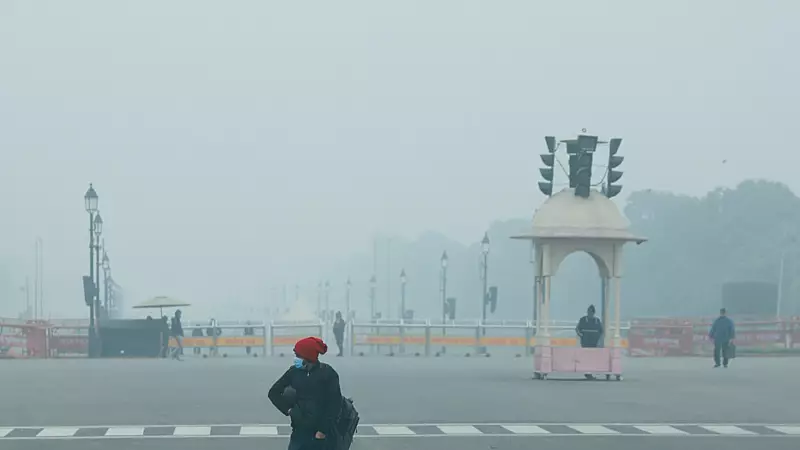
New Delhi has witnessed its most polluted December in seven years, with air quality indicators showing a sharp and alarming reversal from the relatively better conditions experienced last year. Data reveals that the capital's air was laced with dangerously high levels of fine particulate matter throughout the month, affecting nearly every corner of the city.
A City Choking: The Alarming Data
An analysis of information from the Central Pollution Control Board's 40 monitoring stations paints a grim picture. The monthly average concentration of PM2.5 for December 2025 stood at 211 micrograms per cubic metre (µg/m³). This marks a significant deterioration, showing an increase of over 40 µg/m³ compared to December 2024.
The pollution was not limited to short episodes. On nearly one out of every three days, the citywide average PM2.5 level crossed the severe threshold of 250 µg/m³. For more than 82% of the month, the levels remained above 150 µg/m³. The most severe phase occurred in mid-December, when average pollution soared to six or seven times the national safe standard of 60 µg/m³.

Peaks, Patterns, and Persistent Emissions
The peak of the crisis was recorded on December 14, when Delhi's station-averaged daily PM2.5 hit 392.65 µg/m³, the highest single-day value since December 23, 2018. The previous day, December 13, also saw a severe average of 360.12 µg/m³.
Manoj Kumar, a pollution analyst at the Centre for Research on Energy and Clean Air (CREA), highlighted a critical finding. "The absence of stubble burning during this peak makes it evident that Delhi’s air pollution is also being driven by persistent, year-round emissions," he stated. Kumar emphasized the need for enforceable, sector-specific reduction targets for industries, transport, and power plants, moving beyond short-term measures.
Sunil Dahiya, lead analyst at the think tank Envirocatalysts, echoed this, noting that favourable weather earlier in the year had masked high baseline emissions. "With the onset of winter, the same hazardous pollution levels were back," he said, criticizing the lack of aggressive action on cleaner technologies and fossil fuels.
A Disparate Burden Across the Capital
The pollution burden was not evenly distributed. Station-level data up to December 29 showed stark contrasts. Anand Vihar was the most polluted location with a monthly mean of 271.83 µg/m³, followed closely by Rohini and Jahangirpuri. At the other end, NSIT Dwarka recorded the lowest mean at 136.95 µg/m³, with IGI Airport and Aya Nagar also on the lower side—though all still far exceeded the national limit.
The extremity of the pollution was shocking at a hyper-local level. On December 14, Mundka station recorded a staggering 597.67 µg/m³—nearly ten times the national standard. Other stations like Ashok Vihar, Rohini, and Wazirpur also registered values above 566 µg/m³. These peaks represent levels 35 to 40 times higher than the World Health Organization's safety guidelines for human health.
Barring two stations, every monitoring location saw PM2.5 cross 250 µg/m³ at least once. While 26 stations exceeded 350 µg/m³, 11 even breached the 450 µg/m³ mark. An analysis of hourly data further indicated that the most severe pollution overwhelmingly occurred during the night hours.
This December's toxic haze underscores a failing system reliant on seasonal responses. The data conclusively points to the necessity of tackling the capital's perennial emission sources with stringent and sustained policy action throughout the year.