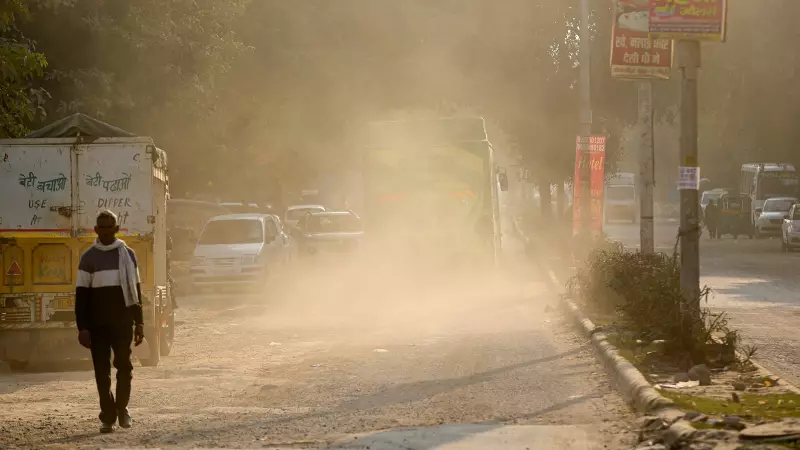
Startling government data has confirmed a harsh reality for India's capital: the unprecedented stillness of the Covid-19 lockdowns was insufficient to cleanse Delhi's toxic air. This revelation underscores the urgent need for a radical, Delhi-specific strategy that moves beyond temporary fixes and reactive measures to tackle a deep-seated environmental crisis.
The Lockdown Illusion and a Persistent Haze
Replies provided by the government in the Lok Sabha on November 29, 2021, and July 18, 2022, delivered a sobering assessment. Even when the city came to a complete halt in 2020, with deserted roads and silent factories, Delhi's air remained dangerously polluted. The city recorded 49 'very poor' and 15 'severe' air-quality days that year. While 2021 saw a slight improvement to 41 and 12 such days respectively, the figures from 2019—56 'very poor' and 24 'severe' days—paint a grim picture of the baseline. This data definitively shatters the simplistic notion that merely reducing vehicular and industrial activity can solve the problem. A more complex and entrenched challenge holds the capital in its grip.
Three Critical Lessons for Delhi's Clean Air Fight
The path forward requires learning from past failures and embracing a new philosophy. Experts point to three fundamental lessons.

First, Delhi's unique geography is its curse. Unlike coastal Chennai or elevated hill stations, Delhi sits on the Gangetic plains, where pollution becomes trapped under a lid of stagnant air. The city has effectively become a reservoir of its own toxicity, necessitating an action plan far more aggressive than any national template.
Second, meteorology is a dominant, often overriding, force. The slight improvement in 2021, despite revived economic activity, highlights how factors like wind speed, temperature inversion, and mixing height control what citizens breathe. While emission sources must be tackled, Delhi must also mitigate its natural disadvantage through sophisticated predictive planning based on weather behaviour.
Third, the current system reacts too late. The cornerstone policy, the Graded Response Action Plan (GRAP), is often implemented after pollution peaks. This delay forces more severe, Stage 3-type shutdowns that harm both public health and the economy more than timely, pre-emptive action would.
From Reaction to Prediction: A Blueprint for Change
The solution is not another alert system but a complete redesign of air-governance philosophy. The focus must shift from control to prevention, and from partial to comprehensive, airshed-wide solutions. A predictive framework using AI, IoT, and satellite data should trigger GRAP measures before safety thresholds are breached.
Government leadership must combine foresight with enforcement. Concrete steps include ensuring stable electricity to eliminate diesel generators, mechanised sweeping and water sprinkling on roads and construction sites, paving every unpaved stretch, and containing landfills. This scale of action is impossible without transforming the fight into a mass movement, moving public sentiment from criticism to active participation.
Micro-level protections for the most vulnerable are also crucial. Simple administrative changes, such as adjusting office hours to align peak traffic with periods of better atmospheric mixing, can make a tangible difference.
Delhi's smog is ultimately a profound test of governance, scientific application, and collective will. The available data proves that the current framework, even at full enforcement, is inadequate. The pressing question is whether Delhi can transition from hope to genuine commitment. This struggle transcends AQI numbers and policy stages; it is about a city reclaiming its moral clarity to ensure its citizens do not have to fight for a single clean breath.