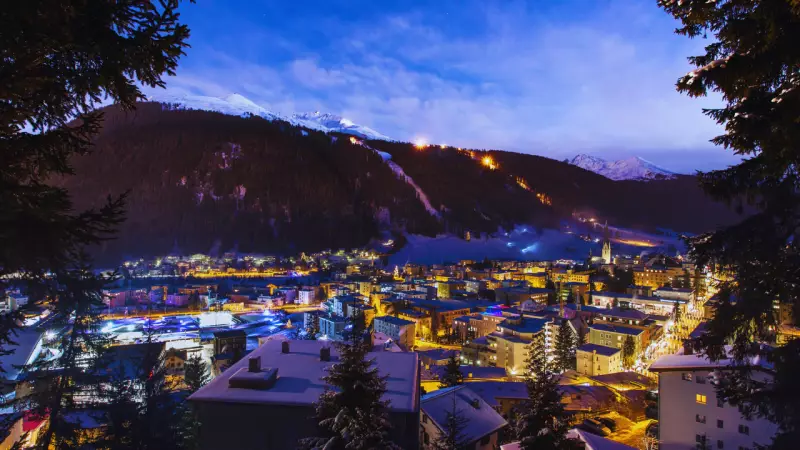
At first glance, Davos appears as the quintessential Alpine paradise. Snow-dusted slopes, dense pine forests, and invigorating mountain air define this picturesque Swiss town for much of the year. Skiers flock here for extensive runs, hikers seek out high-altitude trails, and wellness enthusiasts are drawn by the pristine air that once established Davos as a renowned health sanctuary.
The Annual Transformation
Every January, however, Davos undergoes a remarkable metamorphosis. For several days, this tranquil mountain retreat becomes one of the planet's most scrutinized locations. Presidents, prime ministers, corporate titans, tech innovators, financiers, and activists converge for the annual assembly of the World Economic Forum. A common query among observers is straightforward: why select this remote Alpine setting?
The World Economic Forum: A Global Confluence
The World Economic Forum stands as one of the most potent international platforms, steering dialogues on economics, governance, technological advancement, and societal evolution. Celebrated for its yearly Davos congregation, the forum has, across more than fifty years, matured from a humble management symposium into an emblem of worldwide influence, collaboration, and contention.

Foundations and Evolution
The WEF was established on January 24, 1971, by German engineer and scholar Klaus Schwab, then a business professor at the University of Geneva. Initially named the European Management Forum, its early objective was precise yet bold: to acquaint European corporations with American management methodologies. The inaugural 1971 gathering at the Davos Congress Centre assembled approximately 450 executives from Western European firms, supported by the European Commission and industrial groups.
What commenced as a business-centric assembly soon broadened its horizons, mirroring a swiftly transforming global scene. In 1987, the entity was rebranded the World Economic Forum, signifying a conscious pivot from management principles to wider global involvement. Its proclaimed mission—"improving the state of the world by engaging business, political, academic, and other leaders of society to shape global, regional, and industry agendas"—remains core to its ethos.
The Davos Allure
Annually, in late January, the town accommodates the WEF's premier event: a five-day summit drawing roughly 3,000 attendees, including state leaders, chief executives, investors, economists, scholars, media representatives, and cultural icons. The forum is primarily financed by its about 1,000 multinational corporate members, whose yearly contributions support the organization's operations. During the annual meeting, participants engage in over 500 sessions, spanning from public panels to confidential dialogues.
From Corporate Strategy to Geopolitical Arena
Global occurrences in the 1970s rapidly reshaped the forum's focus. The disintegration of the Bretton Woods monetary framework and the 1973 Yom Kippur War propelled discussions beyond management into economic and geopolitical realms. By 1974, political figures were officially welcomed.
In its nascent years, the Davos meeting maintained a casual, even leisurely ambiance. Attendees would ski by day and network by night. This mood soon shifted. By the late 1980s and 1990s, Davos had emerged as a venue for critical diplomacy. The 1988 Davos Declaration assisted in mitigating strains between Greece and Turkey. In 1992, South African President F. W. de Klerk convened with Nelson Mandela and Mangosuthu Buthelezi at Davos, marking their initial joint appearance beyond South Africa. Two years later, Israeli and Palestinian authorities conducted pivotal negotiations during the forum.
The forum also influenced post-Soviet politics. The 1996 "Davos Pact" witnessed global elites uniting behind Boris Yeltsin amid Russia's chaotic transitional phase.
Davos in a Dynamic World
International crises have often been mirrored at the forum. In a gesture of unity after the September 11, 2001 attacks, the WEF moved its annual meeting to New York City. Davos was employed by US Secretary of State Colin Powell in 2003 to solicit backing for the US-led offensive in Iraq.

Internal scrutiny has surfaced as well. With transparency under watch by entities like Openness International, CEO José María Figueres stepped down in 2004 over undisclosed consulting remunerations.
More lately, Davos has served as a stage for pivotal global political instances. In 2017, Chinese President Xi Jinping presented a prominent advocacy for globalization amidst Brexit and escalating protectionism. In 2018, Indian Prime Minister Narendra Modi became the first Indian head of government to deliver the opening plenary address, pinpointing climate change, terrorism, and protectionism as collective worldwide threats.
Pandemic Upheaval and Contemporary Shifts
The COVID-19 pandemic mandated unprecedented alterations. The 2021 meeting was annulled, and the 2022 forum was deferred to May owing to the Omicron variant. That year's schedule was overwhelmed by the Russian incursion into Ukraine, inflation, and energy instability. Ukrainian President Volodymyr Zelenskyy spoke to the forum, while Russia was omitted for the first time since 1991. The 2023 annual meeting, conducted under the motif "Cooperation in a Fragmented World", echoed escalating geopolitical rifts and economic unpredictability.
Klaus Schwab disclosed in April 2025 that he was resigning as chair and trustee of the WEF at age 88, concluding a leadership spanning over five decades. Recent disclosures of financial impropriety and a problematic work environment by WEF personnel prompted a fresh scrutiny of the organization in recent months. Despite autonomous inquiries uncovering no proof of misconduct, the WEF proclaimed a revision of its protocols. Until a new president is identified, interim leaders Larry Fink and André Hoffmann have been enlisted. This year also witnessed significant progressions and deliberations on subjects ranging from artificial intelligence, energy, defense, and beyond.
Influence, Power, and Critique
Parallel to its impact, the WEF has persistently drawn censure. Critics charge it with magnifying elite agendas, advancing corporate supremacy, lacking openness, and fostering environmental damage, particularly considering the carbon imprint of thousands of private jets arriving in Davos. Advocates contend that the forum's merit resides not in official resolutions, but in discourse that might otherwise not transpire.