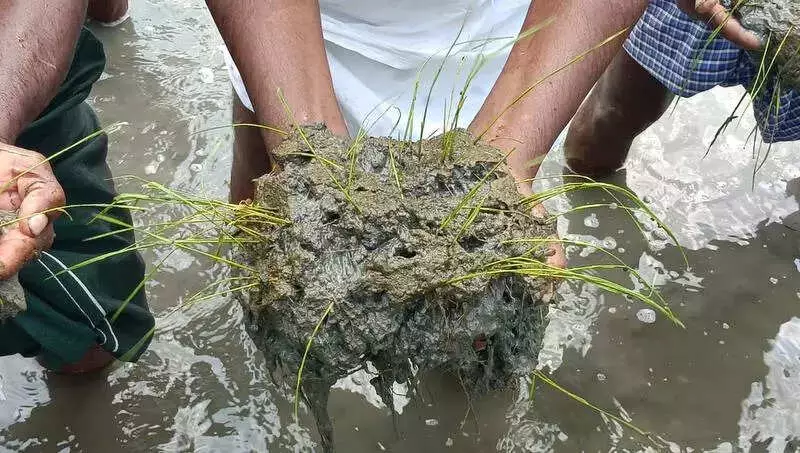
The recent Cyclone Ditwah has left a trail of agricultural devastation in Tamil Nadu's central and coastal regions, with initial government assessments revealing extensive damage to standing paddy crops. The cyclone's intense rainfall has severely impacted the livelihoods of thousands of farmers in the crucial Cauvery delta.
Extent of the Damage and Government Assessment
According to the Tamil Nadu government's detailed assessment, the cyclone has caused significant crop damage on nearly 50,000 hectares, which is over 1.2 lakh acres. This staggering figure represents approximately 11% of the total cultivated area in the affected districts. The disaster struck at a critical growing period, inundating more than 82,000 hectares (over 2 lakh acres) of young paddy crops.
The worst-hit areas include Trichy, Thanjavur, Tiruvarur, Nagapattinam, Mayiladuthurai, and Cuddalore districts. In these regions, about 4.5 lakh hectares were under cultivation for the samba and thaladi paddy seasons. Officials have verified that more than 61% of the total inundated area has suffered damage beyond the permissible threshold limit for compensation.

Farmers' Plight and Personal Stories of Loss
The cyclone's impact has been particularly brutal for farmers who cultivate paddy only once a year, focusing on the single samba season. Their losses are more acute compared to those who farm in two seasons, such as kuruvai and thaladi.
M Rajadurai, a 48-year-old farmer from Nallanayagapuram in Mayiladuthurai district, embodies this crisis. "I have suffered irreversible crop loss across about 17 acres in two villages," he said. "My investment of around two lakh has been wiped out, and I still need to repay my loans. The announced relief will not provide much assistance." His story highlights the precarious financial situation many farmers now face.
While some farmers found mild relief as floodwaters receded, allowing partial survival of their crops, concerns about drastically reduced yields persist. R Ravi, a 48-year-old farmer from Aathanur in Nagapattinam, lost half of his 10-acre cultivation. "The surviving crops were submerged for days, and yield may come down significantly at harvest," he added, pointing to a looming secondary economic blow.
Relief Measures and Survey Challenges
In response to the calamity, the state government has committed to providing Rs 20,000 per hectare (approximately Rs 8,086 per acre) as compensation for paddy fields where damage exceeds 33%. Since December 1, joint teams from the agriculture and revenue departments have been conducting field surveys to assess losses and facilitate relief disbursal from the State Disaster Response Fund (SDRF).
The assessment process itself faced hurdles. Initially, officials used a dedicated Crop Damage Assessment app to record losses, capturing land survey numbers, farmer details, crop information, damage extent, and geotagged photographs. However, following protests from farmers over the app's practical challenges in the field, the authorities shifted to a manual survey approach.
A senior official from the agriculture department provided an update: "The assessment process is now complete. The district administration will forward the report to the government soon. Processing will follow, and relief amounts will be credited to affected farmers at the earliest." This manual verification aims to ensure that aid reaches all eligible farmers without technological barriers causing further delay or exclusion.
The aftermath of Cyclone Ditwah underscores the persistent vulnerability of India's agricultural heartlands to extreme weather events. As the delta region, often called the rice bowl of Tamil Nadu, recovers, the focus remains on timely relief and long-term strategies to build resilience among the farming community.