

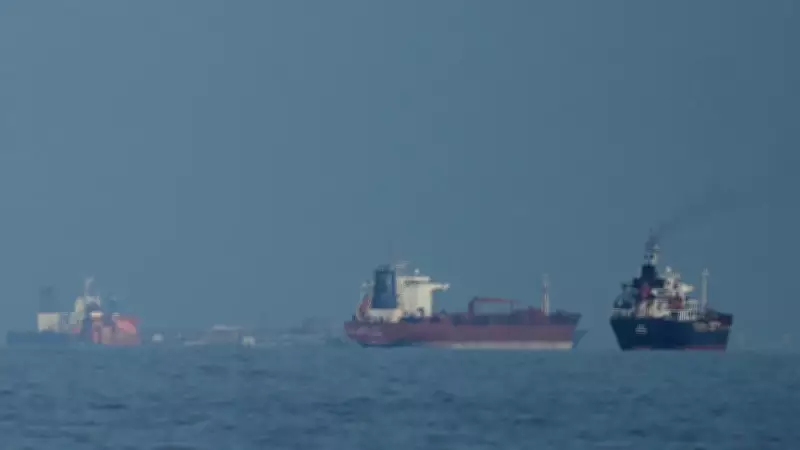
Chinese-Linked Container Ships Make Abrupt U-Turn Near Strait of Hormuz
In a development that underscores the escalating tensions in the Middle East, two large container ships linked to China made a sudden reversal near the strategically vital Strait of Hormuz on Friday. This occurred as Iran continues to strengthen its control over one of the world's most crucial maritime passages for global shipping.
Ship Tracking Reveals Unexpected Maneuver
According to detailed ship-tracking data, the vessels CSCL Indian Ocean and CSCL Arctic Ocean, both associated with China's state-owned COSCO Shipping, attempted to exit the Gulf in the early morning hours. However, they abruptly turned back in close proximity to Iranian territorial waters near Larak and Qeshm islands at approximately 0350 GMT.
This marked the first known attempt by a major international shipping operator to leave the Gulf region since the outbreak of the broader conflict. Both ships had reportedly been stranded in the area for several weeks prior to this maneuver.

Contradiction with Iranian Assurances
The ships' reversal is particularly notable given recent diplomatic statements from Tehran. Just one day earlier, Iran's Foreign Minister Abbas Araghchi had publicly declared that vessels from five "friendly" nations—China, Russia, India, Iraq, and Pakistan—would be granted safe passage through the Strait of Hormuz.
Analysts cited by the Wall Street Journal described the incident as "unusual" considering these prior signals. Rebecca Gerdes, an analyst at Kpler, told Reuters that the episode demonstrates that "safe passage could not be guaranteed" despite Tehran's diplomatic messaging.
Strategic Adjustments and Maritime Tactics
Bloomberg reported that the two vessels had previously altered their tracking signals to indicate Chinese ownership and crew composition. This tactic has been employed by ships seeking to avoid confrontation in the volatile waterway.
The broader context reveals that Iran has effectively brought the Strait of Hormuz under its control since regional conflicts escalated. This strategic chokepoint normally handles approximately one-fifth of global oil and gas flows.
Iran Implements De Facto 'Toll Booth' System
Industry data and maritime intelligence reports indicate that Tehran is increasingly operating what amounts to an approval system for vessels seeking transit through the strait.
- Vessels may be required to submit detailed information about cargo, ownership, and crew for clearance
- Some ships have reportedly paid fees—denominated in Chinese yuan—to secure passage
- Approved vessels sometimes receive Iranian escorts through controlled routes
Maritime intelligence firms have characterized this arrangement as a "toll booth" model, effectively allowing Iran to regulate which ships move through the strait and under what specific conditions.
Selective Passage and Continued Disruptions
While some vessels, particularly those carrying goods destined for Iran, have been permitted through in recent days, many others remain stranded. On Friday alone, Iranian forces claimed to have warned off three container ships of various nationalities attempting to cross.
Iran has indicated that vessels linked to countries perceived as supporting the United States or Israel could be denied passage entirely, creating a complex patchwork of approvals and restrictions for shipping companies.
Severe Impact on Global Shipping and Energy Markets
The broader consequences for international maritime trade have been substantial and far-reaching.

Traffic Collapse and Security Concerns
- Traffic through the Strait of Hormuz has plummeted by 90–95% since early March
- Only a fraction of normal daily vessel movements are currently occurring
- Approximately 20,000 seafarers are believed to be stranded in the Gulf region
- Security risks have intensified, with multiple attacks on commercial vessels reported since the conflict began
- Many ships are now navigating the region with tracking systems disabled, reflecting heightened fears of targeting
Energy Market Disruption and Geopolitical Implications
The shipping disruption has sent shockwaves through global energy markets, with exports of crude oil and liquefied natural gas from Gulf producers sharply curtailed. Despite the broader slowdown, Iranian oil shipments—particularly to smaller Chinese refineries—appear to have continued, suggesting Tehran is leveraging its strategic control to maintain crucial export flows.
Geopolitical tensions remain elevated, with the United States and Iran exchanging proposals through intermediaries. However, the situation both on land and at sea continues to deteriorate, creating ongoing uncertainty for global trade and energy security.





