

Centralia: The Pennsylvania Town Burning Underground for Over 60 Years
For more than six decades, an American town has been smoldering beneath the surface, its streets abandoned and homes demolished. Centralia, Pennsylvania, once a thriving coal community, has been slowly erased from the map by a relentless underground fire that continues to burn today.
A Town Built on Coal
Centralia's story began in the early 19th century as a small settlement known as Bull's Head, later renamed Centreville. The discovery of anthracite coal in the 1840s transformed the area, and by the time Centralia Borough was formally incorporated in 1866, mining had become the backbone of local life. Throughout the late 19th and early 20th centuries, Centralia developed into a bustling town with shops, churches, and social halls, sustained by a close-knit community built around the collieries that ran beneath it.
By 1890, more than 2,700 people called Centralia home, with most residents tied directly or indirectly to the mines that shaped everyday existence. The town's central role in mining also drew it into the labor conflicts that defined the coalfields, including associations with the infamous Molly Maguires in the 1860s. Despite economic downturns, including the Great Depression that forced many mines to close, Centralia persevered through hardship. What ultimately destroyed the town was not economic collapse, but an uncontrollable fire.

How the Fire Began
The blaze that doomed Centralia is generally traced to May 1962, when local authorities attempted to clean up a municipal rubbish dump ahead of Memorial Day celebrations. The landfill sat inside an abandoned strip pit, roughly 75 feet wide and 50 feet deep, left behind after surface mining in the 1930s. Setting rubbish alight was not unusual at the time—Centralia Council's standard method for clearing dumps was simply to burn them.
What officials did not fully account for was the pit's connection to a vast network of abandoned underground coal workings. The trash fire is believed to have breached a poorly constructed barrier, igniting carbon-rich refuse and spreading into the Buck Mountain coal seam below. Once the fire reached the mines, it became almost impossible to contain, setting in motion a disaster that would consume the town.
A Fire No One Could Stop
Coal seam fires are among the hardest industrial disasters to contain, and Centralia proved to be a worst-case scenario. By the time officials understood what they were dealing with, the blaze had already reached a vast lattice of abandoned mine workings beneath the town—tunnels dug over decades, many unmapped, all capable of feeding the fire with fresh oxygen.
State and federal agencies tried repeatedly to stop the inferno. Crews excavated trenches in attempts to cut off the fire's advance, pumped water and fire-retardant slurry into the mines, sealed shafts, and dug isolation barriers meant to starve the flames. By the early 1980s, Pennsylvania had spent more than $7 million on suppression efforts, but none worked. The sheer number of interconnected tunnels made it impossible to determine which passages were sustaining the fire, let alone seal them all.
As years passed, conditions worsened dramatically. Temperatures underground rose to more than 900°F in some locations. Carbon monoxide seeped into homes, forcing the closure of local mines and triggering health complaints from residents. Smoke escaped through fissures and sinkholes, some opening without warning in gardens and backyards. In 1981, the danger became undeniable when a 12-year-old boy fell into a sinkhole that suddenly opened beneath his feet, dropping him into a vent connected to the fire below. He survived only because a relative grabbed him in time.
Abandoning Centralia
By the early 1980s, the federal government concluded that saving the town was no longer viable. Instead of extinguishing the fire, Congress approved a buyout of Centralia's residents, paying families to relocate. Over the following years, homes were systematically demolished and streets emptied. In 1992, Pennsylvania formally condemned all remaining buildings and moved to evict the last holdouts. Centralia's ZIP code was eliminated entirely.

Only a handful of residents were allowed to stay under a court order, on the condition that they could not sell or pass down their property. What remained was a town without a future, sitting above a fire with no end in sight—a ghostly landscape where foundations tilted, the ground felt warm to the touch, and even cemeteries seemed unsafe as graves threatened to sink into the burning void below.
Still Burning, Still Dangerous
Today, Centralia is largely uninhabited, but the fire continues unabated. It is one of at least 38 active mine fires in Pennsylvania, and by far the most destructive. The state's Department of Environmental Protection warns that the blaze could burn for another century if left uncontrolled. The area remains hazardous, with toxic gases that can accumulate without warning and ground prone to sudden collapse. Officials strongly discourage visitors from entering the fire zone, warning that serious injury or death is possible.
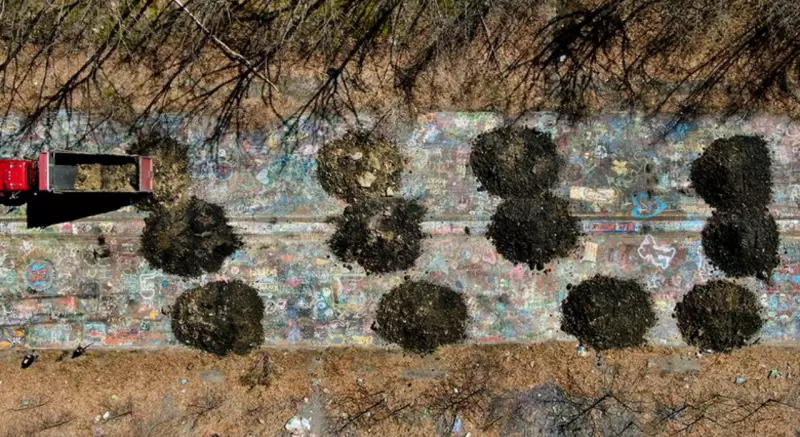
Despite these dangers, Centralia became a magnet for curiosity over the past three decades. The town emerged as an unusual tourist destination, largely because of the abandoned stretch of Route 61 later dubbed "Graffiti Highway," which evolved into an unofficial outdoor gallery as visitors and street artists covered it in colorful artwork. In 2020, the privately owned road was buried under piles of dirt in an effort to deter crowds during the COVID-19 pandemic, effectively concealing the graffiti that had become its defining feature.
From Real Disaster to Cultural Myth
Centralia's eerie landscape has left a significant mark on popular culture. The town served as the primary visual and narrative inspiration for the 2006 horror film Silent Hill, which drew directly on its smoke-filled streets, toxic air, and forced abandonment. More than six decades after the fire began, Centralia stands as a stark reminder of how industrial decisions can echo for generations.
What started as a routine rubbish burn became an environmental catastrophe that erased an entire town from existence. The fire continues to burn quietly and relentlessly beneath Pennsylvania soil—a subterranean inferno that transformed a thriving community into a cautionary tale about the lasting consequences of industrial oversight.





