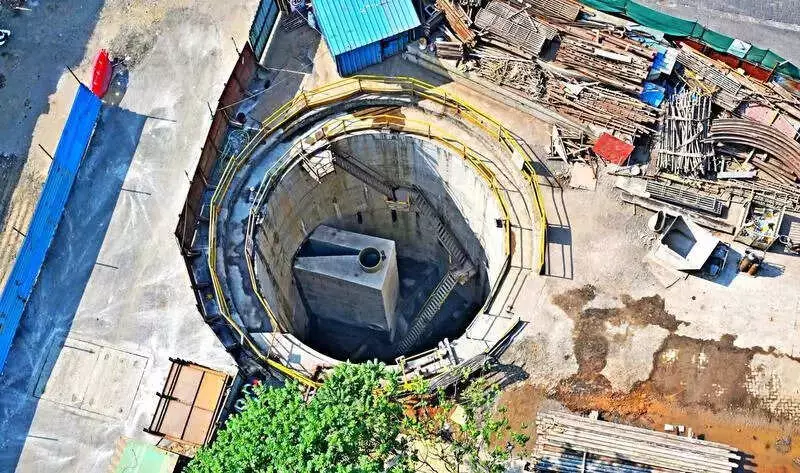
As Mumbai's civic body pours thousands of crores into ambitious projects to revive the heavily polluted Mithi river, a critical question lingers: will these massive interventions finally stop the sewage, flooding, and stench that have plagued the waterway for generations? While the scale of the current sewage-diversion push is acknowledged, experts caution that engineering marvels alone may not be the silver bullet for this complex environmental crisis.
Beyond Mega Tunnels: The Case for Localised Solutions
Rakesh Kumar, former director of the National Environmental Engineering Research Institute (NEERI) and head of a Supreme Court-appointed expert committee on Mithi, welcomed the large-scale efforts but highlighted inherent complexities. He pointed out that "interception, diversion and treatment" projects are highly intricate, take a long time to complete, and are rarely foolproof solutions.
Kumar emphasised a more fundamental approach: "Capturing sewage at the source is always more effective than trying to reroute it kilometres away." This echoes recommendations from IIT-Bombay, suggesting that treatment and reuse of wastewater at its origin could help maintain a perennial flow in the river. He also noted that the 2018 expert committee report had advocated for multiple nature-based solutions alongside engineering works.
The pollution, experts stress, is not monolithic. Kumar warned that a significant portion of the river's degradation stems from unmanaged municipal solid waste, plastic, sludge, industrial effluent, and construction debris. "Unless these inputs are stopped at the neighbourhood level, engineering solutions alone will not deliver a clean river," he stated.
Engineering Feats vs. Ecological Neglect
The stark contrast between Mumbai's capability to execute complex infrastructure projects and its failure to clean a 17-kilometre river was highlighted by A.D. Sawant, a civil society member of the expert committee and former pro-vice-chancellor of Mumbai University. "We've built the Coastal Road, an underground metro line, deep tunnels — all projects of enormous complexity. Yet Mithi remains foul," he observed. Sawant stressed that a large part of Mithi's pollution is human-driven and insisted that the river's bay must be declared a strict no-development zone for any meaningful recovery.
Architect P.K. Das, another civil society member on the committee, argued for an ecological paradigm shift. He lamented that the river has been turned into an impervious, concrete-lined channel, destroying natural symbiotic relationships. "Instead of attending to ecological restoration, the focus by the authorities has been only on large engineering budgets. But technology alone cannot save the river; unless we revive its ecology, nothing will change," Das said. He pointed to global best practices that now favour breaking concrete embankments and creating eco-sensitive riverfronts.
Operational Challenges and the Risk of a Dry River
Another concern raised is the potential unintended consequence of large-scale sewage interception. Rishi Agarwal, co-founder of Mithi Sansad, warned that diverting all dry-weather flow could leave vast stretches of the river bone-dry for most of the year, outside the monsoon season. This could create a new set of ecological problems.
Agarwal also pinpointed the challenge of reliable operations, stating that even the most advanced infrastructure "unless they are run optimally, 24x7, we won't see real change on the ground." This underscores that construction is only half the battle; sustained and efficient management is crucial.
Kumar reflected on the history of rejuvenation attempts, noting that over the past two decades, multiple efforts—including channelisation, widening, desilting, and flood-mitigation works—have been undertaken. Yet, the core problem of pollution and degradation persists. He cautioned that large tunnelling projects carry uncertainties, and there is no guarantee a diversion tunnel of such scale will deliver 100% results.
The consensus among experts suggests that the path to a clean Mithi requires a multi-pronged strategy. It must combine large-scale infrastructure with robust, localised waste management, stringent protection of the river's course and bay, and a committed shift towards ecological restoration. The success of Mumbai's costly revival mission hinges on moving beyond concrete and tunnels to embrace the river's natural ecology and address pollution at its very source.