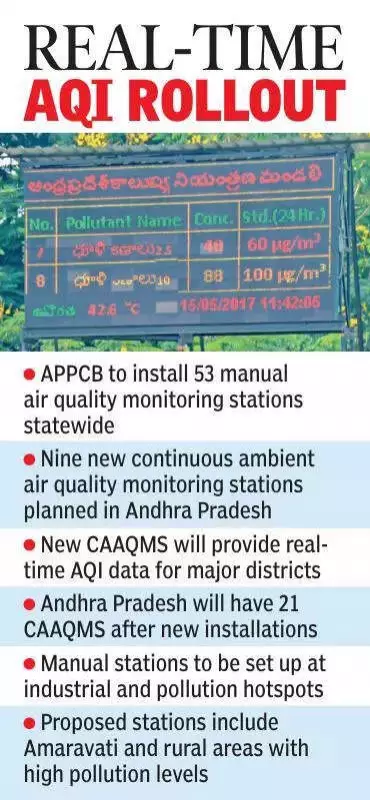
In a significant move to combat environmental pollution, the Andhra Pradesh Pollution Control Board (APPCB) is launching a major expansion of its air quality monitoring infrastructure across the state. The board plans to establish a comprehensive network of new stations to create a detailed pollution matrix for Andhra Pradesh.
Massive Expansion of Monitoring Network
The expansion plan involves two key components. First, the board will set up 53 new manual air quality monitoring stations sanctioned by the Central Pollution Control Board (CPCB) under the National Air Quality Monitoring Programme (NAQMP). These stations will cover all urban local bodies and towns in the state.
Second, and crucially for real-time data, the APPCB will install nine new continuous ambient air quality monitoring stations (CAAQMS). These high-tech stations provide real-time air quality index (AQI) levels. The new CAAQMS will be located in the district headquarters of Srikakulam, Vizianagaram, Kakinada, Machilipatnam, Guntur, Nellore, Ongole, and Kurnool.

Focus on Pollution Hotspots and Industrial Zones
APPCB Chairman P. Krishnaiah explained the strategic placement of the new manual stations. He stated that the 53 manual stations will be installed at identified pollution hotspots. These include areas with cement industries, thermal power stations, and other industrial zones where pollution levels are significantly higher due to industrial activity.
Krishnaiah specifically mentioned areas like Chimakurthi in Prakasam district and Kondapalli in NTR district, which have high pollution from stone-crushing and mining activities. Currently, the APPCB lacks a detailed pollution matrix for these critical locations, a gap this expansion aims to fill.
Of the 53 manual stations, three will be set up in the capital region of Amaravati, while five will be established in rural areas. This addition will build upon the state's existing network of 72 manual air quality monitoring stations.
Real-Time Coverage and Remaining Gaps
The installation of the nine new CAAQMS will boost the state's real-time monitoring capacity. Currently, Andhra Pradesh has 12 CAAQMS at nine locations. With the new additions, the total will rise to 21 real-time monitoring stations.
However, despite this expansion, real-time pollution monitoring will still not cover all districts. As many as 10 districts remain without CAAQMS coverage. The districts awaiting these advanced stations are Parvathipuram Manyam, Alluri Sitharama Raju (ASR), Anakapalli, Dr. B.R. Ambedkar Konaseema, West Godavari, Palnadu, Bapatla, Nandyal, Sri Satya Sai, and Annamayya.
This ambitious project underscores the state government's focus on building a data-driven approach to environmental management. The enhanced network will provide authorities with accurate, location-specific data to formulate targeted action plans for pollution control and public health protection across Andhra Pradesh.