AI Model Forecasts Drastic 40% Reduction for Bhopal's Vital Upper Lake by 2050
In a stark warning for urban water security, a groundbreaking AI tool developed by scientists from the Indian Institute of Science Education and Research (IISER) Bhopal and Maulana Azad National Institute of Technology (MANIT) Bhopal predicts that the iconic Upper Lake of Bhopal could shrink by a dramatic 40% by the year 2050. This alarming projection is specifically tied to scenarios where global temperatures rise by 2°C—the critical threshold established by the landmark 2015 Paris Agreement on climate change.
Implications for a Critical Water Source and Ecosystem
The potential shrinkage spells significant trouble for Bhopal's municipal water supply, local fisheries, rich biodiversity, and regional drought severity. The Upper Lake is not merely a scenic landmark; it holds the prestigious designation of a Ramsar site, recognizing its international importance as a wetland. Crucially, it serves as a vital source, providing approximately 40% of the city's drinking water. The joint research study was recently published in the esteemed international journal Remote Sensing Applications: Society and Environment.
The study details that by 2050, seasonal water levels are expected to experience wild fluctuations. This includes more frequent and prolonged low-water periods during pre-monsoon dry spells, significantly weaker recharge from monsoonal rains, and a paradoxical reduction in extreme flood events. "The lake faces more frequent dry spells and weaker recharges," cautioned Professor Somil Swarnkar, a key member of the research team.

Overcoming Data Gaps with a Hybrid AI Powerhouse
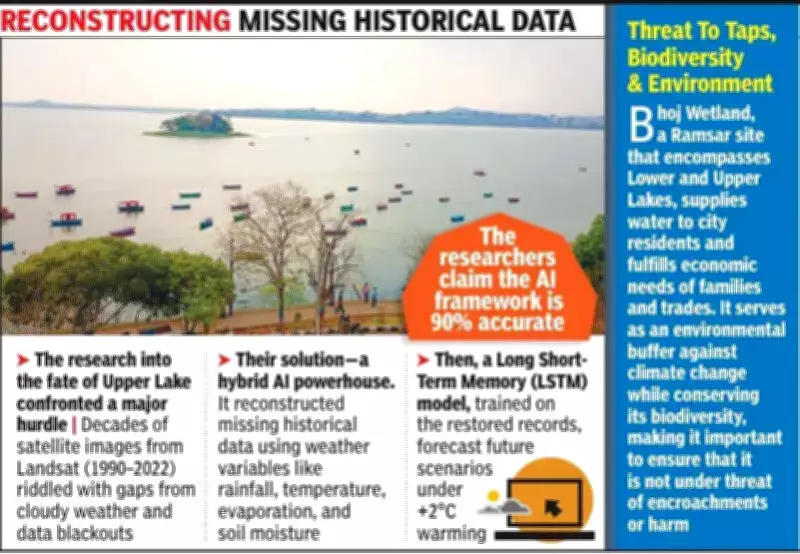
The research team, led by Roshan Nath and including Prof. Somil Swarnkar, Dr. Vikas Poonia, and Dr. Vinod K. Kurmi, confronted a major scientific hurdle at the outset. Decades of satellite imagery from Landsat, spanning from 1990 to 2022, were riddled with gaps caused by persistent cloudy weather and technical data blackouts.
Their innovative solution was a sophisticated hybrid AI system. First, a feed-forward neural network was deployed to reconstruct the missing historical data. This model utilized key weather variables such as rainfall, temperature, evaporation rates, and soil moisture to fill in the blanks. Subsequently, a Long Short-Term Memory (LSTM) model was trained on this newly restored and complete dataset. This LSTM model was then used to generate the future climate projections under the +2°C global warming scenario.
"Urban sprawl, pollution, and climate shifts are squeezing these vital hubs for groundwater recharge and ecosystem balance," Professor Swarnkar explained. "Yet this AI framework shines with an impressive 90% accuracy, proving it can effectively revive spotty Landsat data through advanced kernel fixes and Bayesian tweaks."
A 'Plug-and-Play' Toolkit for Global Water Security
What sets this research apart is the development of a versatile 'plug-and-play' system. This AI framework is not limited to Upper Lake; it can be applied to any data-scarce lake or wetland worldwide. This offers immense hope for monitoring India's vast network of water bodies and for developing nations that often lack extensive environmental monitoring infrastructure.
The tool effectively provides policymakers with a 'crystal ball,' enabling them to anticipate water shortages, devise proactive green policies, and work towards meeting United Nations sustainability targets. In an era characterized by scorching summers and increasingly unreliable monsoon patterns, this fusion of satellite technology, climate data, and artificial intelligence represents more than just a technological achievement.
Researchers argue it could be an essential toolkit for survival. "Water security defines our era," the team stressed emphatically. The predictive power of this AI model allows cities like Bhopal to translate dire forecasts into concrete, preemptive action—potentially averting crisis before vital lakes run dry.