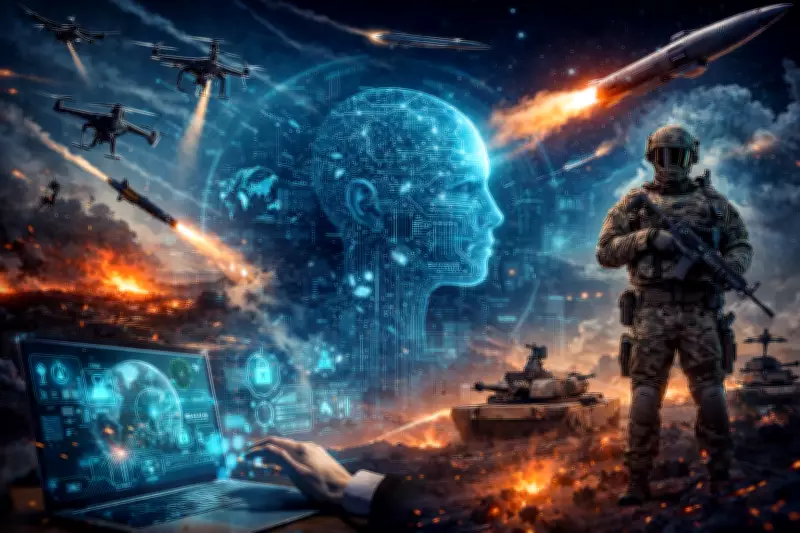
From Missiles to AI Drones: The 30-Year Evolution of Modern Warfare
Over the past three decades, the landscape of warfare has undergone a profound and irreversible transformation. The era dominated by brute force, conventional firepower, and large-scale troop deployments has given way to a complex, technology-driven ecosystem. This new paradigm is defined by artificial intelligence, unmanned aerial systems, sophisticated cyber operations, and precision-guided weaponry that operate across multiple domains.
The Fundamental Shift in Battlefield Dynamics
What was once a battlefield ruled by tanks, artillery pieces, and fighter jets is now increasingly shaped by algorithms, advanced sensors, and autonomous systems. These technologies operate seamlessly across land, sea, air, space, and cyberspace, creating an interconnected web of military capability. As Dr. O. Prasada Rao notes in a UNI Special report, "The 21st century has ushered in an era of Artificial Intelligence (AI), drones, robots, and advanced missile systems." These innovations are not merely changing how wars are fought—they are redefining how conflicts are prevented, deterred, and even conceptualized by military strategists.
Contemporary conflicts, from Eastern Europe to West Asia, demonstrate that wars are no longer decided only after the first missile is launched. Increasingly, outcomes are shaped much earlier through sophisticated cyber intrusions, electronic warfare capabilities, and AI-driven intelligence systems that quietly prepare the battlefield long before conventional forces engage.

The Artificial Intelligence Revolution: Speed, Scale and Decision Dominance
Artificial intelligence has emerged as the central nervous system of this military transformation. Modern militaries are no longer constrained by human cognitive limits in processing information. AI systems can analyze vast volumes of data in mere seconds, identifying patterns, anomalies, and potential threats that would take human analysts hours or even days to detect.
Programs such as the US Department of Defense's Project Maven exemplify this paradigm shift. These initiatives use artificial intelligence to process surveillance imagery and identify potential targets with unprecedented speed, dramatically compressing the decision-making cycle. As the UNI Special report notes, AI is already extensively deployed for "surveillance, logistics, and decision-support systems," fundamentally altering operational planning and execution.
The implications extend far beyond mere efficiency gains. AI enables predictive maintenance systems where sensors and machine learning algorithms monitor military equipment in real time, ensuring optimal operational readiness. It also supports sophisticated multi-domain integration, allowing commanders to fuse inputs from satellites, drones, and ground sensors into a single, comprehensive operational picture.
However, this growing autonomy raises critical ethical and strategic concerns. The future of military AI, as the report points out, lies in systems "capable of making independent decisions in real time." This development has sparked intense global debate over lethal autonomous weapons systems, often referred to as "killer robots," which can potentially select and engage targets without direct human intervention.
Drones: Democratizing Air Power and Reshaping Tactics
If artificial intelligence represents the brain of modern warfare, drones have become its eyes and increasingly its strike arm. Over the past decade, unmanned aerial systems have evolved from simple reconnaissance tools into precision weapons that are fundamentally reshaping battlefield tactics and military economics.
Militaries worldwide now deploy drones for surveillance, targeting, and direct combat operations. The dramatic rise of First-Person View (FPV) drones, capable of striking armored targets with remarkable accuracy, demonstrates how relatively low-cost systems can deliver high-impact battlefield results. These platforms provide real-time situational awareness while significantly reducing risks to human soldiers.

The next frontier lies in coordinated drone swarms. As described in the UNI report, these consist of "a large group of drones flying together in a coordinated manner, much like a flock of birds." Powered by artificial intelligence, these swarms can overwhelm traditional air defenses, attack from multiple directions simultaneously, and adapt dynamically if individual units are destroyed.
This development marks a fundamental shift in military economics. Expensive air defense systems can be forced to engage cheap, expendable drones, creating an economic asymmetry that strongly favors the attacker. In practical terms, air power is no longer the exclusive monopoly of advanced air forces but has become increasingly accessible to smaller states and even non-state actors.
Robotics on the Frontline: Reducing Human Risk and Raising Ethical Questions
Robotics represents another critical pillar of this military transformation. On contemporary battlefields, robots are already deployed for explosive ordnance disposal, logistics support, and medical evacuation operations. Autonomous ground vehicles can transport essential supplies through hostile environments, significantly reducing exposure for human soldiers.
The UNI Special highlights how military robotics is advancing rapidly, with future systems expected to operate in increasingly complex environments and make independent decisions when integrated with artificial intelligence. In parallel civilian sectors, similar technologies are enhancing productivity across industries and enabling unprecedented precision in healthcare applications.
Yet the military application of robotics raises profound ethical and strategic questions. Replacing human soldiers with machines could potentially reduce casualties but might also lower the threshold for initiating conflicts. The debate over accountability becomes exponentially more complex when life-and-death decisions are made by algorithms rather than identifiable human individuals.
Missile Technology: Faster, Smarter, and Harder to Intercept
Missile technology has also evolved dramatically over the past thirty years. From relatively predictable ballistic trajectories, modern systems have progressed toward unprecedented precision, maneuverability, and autonomous operation.
Today's advanced missiles are equipped with AI-enhanced guidance systems that allow them to adjust their trajectory in real time, improving accuracy while evading defensive systems. The development of hypersonic missiles by major powers including the United States, Russia, and China represents a further technological leap. Traveling at speeds exceeding Mach 5, these weapons are extremely difficult to intercept using conventional defense systems.
As the UNI report notes, such advanced missiles can "adjust their trajectory during flight, evading detection and countermeasures." This capability dramatically compresses reaction times and complicates defense planning, potentially increasing the risk of escalation during international crises.
The Invisible Battlefield: Cyber and Electronic Warfare
Perhaps the most significant shift in modern warfare is the rise of invisible domains. Cyber and electronic warfare now shape conflicts long before conventional weapons are deployed, operating in realms that were once considered science fiction.
A modern conflict may begin with sophisticated cyber intrusions, electronic jamming operations, and information campaigns designed to disrupt an adversary's critical systems and decision-making processes. The concept of a "Fire Sale" operation illustrates this evolution perfectly. Rather than a single catastrophic attack, it involves a coordinated, multi-phase assault targeting critical infrastructure across multiple sectors.
As outlined in recent strategic analysis, such an operation could begin with "silent access and preparation," where attackers infiltrate networks months or even years in advance. Subsequent phases could systematically target power grids, telecommunications networks, GPS systems, and financial infrastructure. The objective is not immediate destruction but systemic paralysis, where electricity outages cascade into communication failures, disrupting banking, transportation, and emergency services.
This form of warfare exploits the fundamental interdependence of modern societies. Contemporary civilizations rely on tightly interconnected systems where failure in one sector can quickly spread to others. The result is not necessarily dramatic collapse but prolonged periods of disruption and uncertainty that gradually erode public confidence and institutional stability.
War Without War: Grey-Zone Conflicts and Strategic Deniability
Cyber and electronic warfare operations typically occur below the threshold of open conflict, offering states plausible deniability. Attribution remains notoriously difficult, allowing countries to probe, test, and disrupt adversaries without triggering full-scale military retaliation.
This strategic ambiguity has made cyber and electronic tools central to modern statecraft. They are routinely used to signal intent, test defensive capabilities, and impose costs while carefully avoiding escalation. Consequently, the traditional line between war and peace has become increasingly blurred and indistinct.
Modern military doctrine now systematically integrates these capabilities with conventional operations. Before tanks advance or aircraft strike, adversary networks and sensors are often targeted digitally to degrade their effectiveness and create tactical advantages.
Real-World Lessons: Fragments of an Emerging Doctrine
While no nation has yet experienced a full-scale, synchronized attack across all domains, recent conflicts offer revealing glimpses of this emerging paradigm. The cyberattacks on Estonia in 2007 disrupted government operations and banking systems. The Stuxnet operation demonstrated how sophisticated malware could physically damage critical infrastructure. Attacks on Ukraine's power grid revealed the vulnerability of energy systems, while the NotPetya malware caused widespread economic disruption far beyond its intended targets.
Taken together, these incidents illustrate how modern warfare combines digital reconnaissance, systemic disruption, and strategic ambiguity. They represent fragments of a larger strategy that could, if fully synchronized and executed, fundamentally redefine the nature of international conflict.
India's Evolving Doctrine: Preparing for Multi-Domain Warfare
For India, this military transformation is not theoretical but represents a pressing strategic reality. As a rapidly digitizing society with complex security challenges, the country faces both significant opportunities and substantial vulnerabilities in this new era.
India's armed forces have increasingly embraced technology-driven warfare. AI-enabled systems now support intelligence analysis, surveillance operations, and operational planning. Cyber capabilities are being systematically strengthened through institutions such as the Defence Cyber Agency, while electronic warfare systems are becoming integral to military operations across all services.
Operation Sindoor offers a revealing glimpse into this strategic shift. Artificial intelligence tools were used extensively for intelligence fusion, target identification, and mission planning. According to Lieutenant General Rajiv Kumar Sahni, these systems helped achieve "strategic dominance" by dramatically improving situational awareness and decision-making capabilities.
The push for indigenization remains central to India's defense strategy. Defence Minister Rajnath Singh has underlined this shift, stating, "Self-reliance has become a national mindset," while emphasizing the critical need to reduce the time from research and development to operational deployment.
The Risks: Ethics, Escalation, and Technological Proliferation
Despite its advantages, the new age of warfare comes with significant risks and challenges. Autonomous weapons systems raise profound ethical concerns about accountability and human control. The proliferation of drone and AI technologies lowers the barrier for non-state actors to conduct sophisticated attacks with limited resources.
As the UNI report warns, extremist groups could potentially weaponize these technologies, using drones for precision strikes or artificial intelligence for propaganda dissemination and recruitment. This democratization of advanced military capabilities increases the potential for asymmetric threats against conventional forces.
There are also serious concerns about unintended escalation. AI-driven systems may act on incomplete or biased data, leading to dangerous miscalculations. In high-speed combat environments where decisions are made in seconds, the margin for error becomes dangerously reduced.
The Future: Integration Over Mere Innovation
The next phase of warfare will not be defined solely by technological innovation but by how effectively these technologies are integrated into cohesive military systems. Artificial intelligence, drone swarms, cyber capabilities, and electronic warfare must operate as interconnected components of a unified system, supported by appropriate doctrine, comprehensive training, and seamless coordination.
Joint operations across the Army, Navy, and Air Force will become increasingly critical. Data sharing protocols, system interoperability, and unified command structures will determine success in multi-domain conflicts where traditional service boundaries become irrelevant.
Simultaneously, global regulation will prove essential to managing these risks. International agreements on autonomous weapons systems, cyber norms, and missile technology controls will play a crucial role in preventing destabilization and maintaining strategic stability.
Conclusion: A New Era with New Responsibilities
The transformation of warfare over the past thirty years reflects a broader shift in how power is exercised in the modern world. From advanced missiles to AI-driven autonomous systems, the battlefield has expanded into domains that are often invisible but profoundly consequential for international security.
As Dr. O. Prasada Rao concludes, "The convergence of AI, drones, robots, and missiles presents both unprecedented opportunities and formidable challenges." The same technologies that enhance precision and reduce human risk can also increase the potential for misuse, escalation, and strategic instability.
The coming decades will be shaped not merely by technological breakthroughs but by the conscious choices societies make in developing and deploying these capabilities. The delicate balance between innovation and control will ultimately determine whether these tools serve as instruments of security or become sources of global instability.
In this new era, wars may be decided long before they are conventionally fought—in data centers, through algorithms, and across networks. Victory may depend not only on traditional firepower but on which nations master the invisible battles that increasingly define modern conflict.