

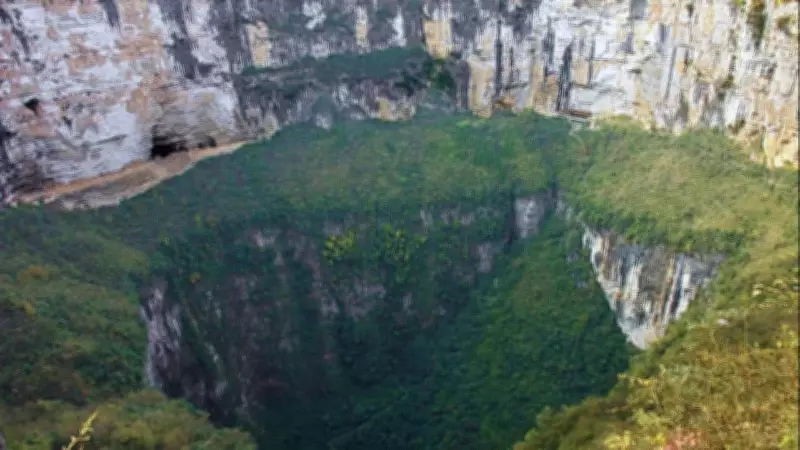
Xiaozhai Tiankeng: The World's Deepest Sinkhole and Its Hidden Ecosystem
In the rugged karst terrain of southwestern China, a geological wonder of immense proportions captures the imagination. Known as the Xiaozhai Tiankeng, or the Heavenly Pit, this colossal depression is recognized as the deepest known sinkhole on Earth. Located in Fengjie County, it has fascinated geologists, explorers, and biologists not only for its staggering size but also for the secret world concealed within its depths.
A Geological Marvel Formed Over Millennia
The Heavenly Pit is not a crater formed by meteorite impacts or volcanic eruptions. Instead, it is a karst-type sinkhole, sculpted over millions of years through the gradual dissolution of limestone bedrock by water. As underground spaces expanded, the ground above eventually collapsed, creating this vast pit. Its dimensions are awe-inspiring: approximately 626 meters in length, 537 meters in width, and a depth ranging from 511 to 662 meters, with a volume exceeding 119 million cubic meters.
Unique Two-Part Structure and Underground River
What sets Xiaozhai Tiankeng apart is its distinctive two-part structure, featuring an upper chamber and a lower chamber. At the heart of its formation lies an underground river within the Difeng cave system. This river, stretching 8.5 kilometers, has been eroding the limestone for thousands of years, leading to the cave roof's collapse and the pit's creation. Today, the river continues to flow beneath the pit, shaping it further and forming dramatic waterfalls, including one that plunges 46 meters deep within the caves. During the rainy season, cascading waterfalls adorn the pit's steep sides.

A Thriving Hidden Ecosystem
Beyond its geological significance, the Heavenly Pit harbors a vibrant and surprising ecosystem. Contrary to expectations of barrenness, scientists have documented over 1,200 species of plants and animals thriving at its base. The pit's steep sides shield it from harsh winds, while the river creates a moist microclimate, fostering lush vegetation. Towering trees, ferns, and ancient species like the ginkgo coexist with rare animals such as the clouded leopard and Chinese giant salamander. This unique environment has led researchers to view the sinkhole as a natural greenhouse, preserving biodiversity in isolation.
Discovery and Exploration
While local communities have long been aware of the sinkhole, it remained unknown to the outside world until 1994, when explorers began mapping the area's caves. This marked the start of scientific exploration and global recognition. The name "Xiaozhai Tiankeng" holds geographical and linguistic meaning: "xiaozhai" refers to a nearby abandoned village, and "tiankeng" translates to "heavenly pit." Today, the site is part of the Tiankeng Difeng scenic area, celebrated for its geological importance.
Experiencing the Heavenly Pit
For visitors, the Heavenly Pit offers more than just a viewing experience; it is an immersive exploration. A staircase of approximately 2,800 steps descends from the rim to the base, allowing adventurers to witness a gradual environmental shift. As one travels downward, temperatures drop, humidity rises, and vegetation thickens. At the bottom, the scale becomes overwhelming, with near-vertical rock walls forming a natural amphitheater that encloses the landscape.
More Than a Record Holder
Xiaozhai Tiankeng is not merely a record holder for depth; it is a testament to the slow, relentless power of geological forces. Over millennia, water has carved stone, and collapse has given rise to life, creating a convergence of geology, hydrology, and ecology. In a world where much land is mapped and understood, this sinkhole retains an air of mystery—a hidden world and geological marvel that offers a glimpse into the unseen realms beneath our feet.






