US Military Buildup in Indo-Pacific Continues Amid Trump's China Partnership Talks
Even as President Donald Trump emphasizes partnership with China, the United States is quietly executing a major military buildup across the Indo-Pacific region. The strategy, reminiscent of Theodore Roosevelt's 'speak softly and carry a big stick' philosophy, involves expanding bases, deploying advanced weaponry, and strengthening alliances to counter an increasingly assertive Beijing.
Trump's Duality on China
During his recent visit to China, Trump stated, 'When we cooperate, both sides benefit; when we confront each other, both sides suffer.' He praised President Xi Jinping as a 'great leader.' However, Trump has historically been a vocal critic of Beijing, engaging in a tariff war last year and making China a central issue in his presidential campaigns. This duality reflects a broader US strategy of diplomatic engagement paired with military deterrence.
Pentagon's 'Big Stick' in the Indo-Pacific
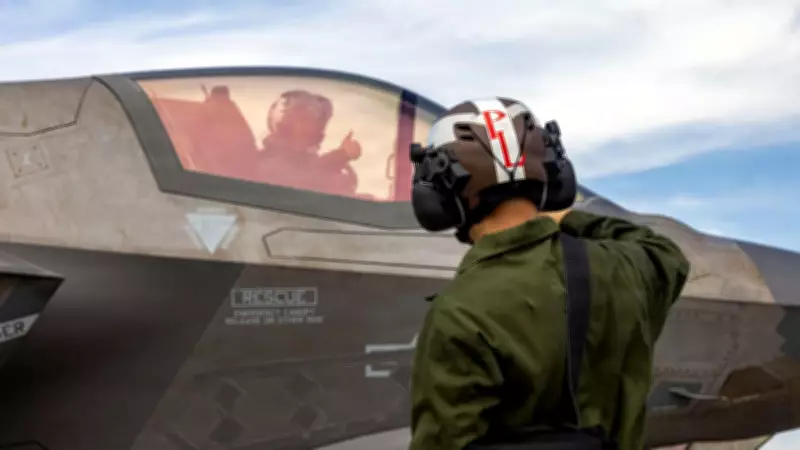
The Pentagon is reshaping its force posture across the Indo-Pacific, investing in advanced weapons platforms and reviving old bases. Key initiatives include the Agile Combat Employment (ACE) program, which disperses forces across smaller bases to reduce vulnerability to Chinese missile strikes. Bases in the Northern Mariana Islands, Tinian, and Guam are being upgraded, along with airfields in Alaska such as Eielson Air Force Base (undergoing a $600 million expansion for F-35 squadrons) and Joint Base Elmendorf-Richardson.

Alliances and Forward Deployments
The US is strengthening alliances under the AUKUS program, providing nuclear-powered submarines to Australia. Military engagements with Japan and the Philippines have increased, exemplified by Exercise Balikatan involving Australia, Japan, France, Canada, and New Zealand. These alliances form a strategic lattice aimed at preventing Chinese dominance in the Taiwan Strait and South China Sea.
Forward deployments of advanced missile systems along the First Island Chain are central to US strategy. HIMARS rocket systems, Typhon land-based launchers, and Navy-Marine Expeditionary Ship Interdiction Systems are being positioned to deny Chinese naval access to the Pacific. Admiral Samuel Paparo, US Indo-Pacific commander, has called for doubling the number of B-21 stealth bombers to 200 for deterrence.
Force Structure and Surveillance
The US Marine Corps is transforming under Force Design 2030, shifting to smaller, mobile units for sea denial operations. The US Navy's 7th Fleet remains the largest forward-deployed fleet. The Pentagon is also expanding space-based surveillance, including the Silent Barker constellation of spy satellites, and offensive cyber capabilities to monitor Chinese maneuvers.
Strategic Implications
This comprehensive buildup, backed by a defense budget exceeding $900 billion, creates a multi-domain deterrence architecture. For Beijing, it raises the cost of aggression in the Taiwan Strait or South China Sea. Even as Trump speaks softly in Beijing, the 'big stick' is being readied to ensure a free, open, and resilient Indo-Pacific.