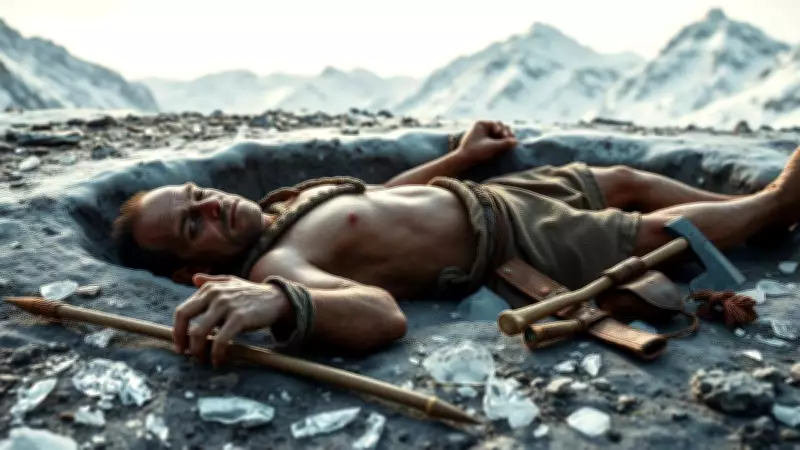
The air is thin in the upper reaches of the Otztal Alps, where the only sounds breaking the silence are footsteps trudging across the snow. It was September 19, 1991, when Erika and Helmut Simon were finishing a long hike along the edge of the Tisenjoch ridge. Seeking an easier route home, they strayed from the marked trail into a crevice filled with glacial melt and rubble. There, something brownish and leather-like caught their eye.
From the outset, the thrill was not of a scientific discovery but an adrenaline surge from realizing they had stumbled upon something disastrous. The couple had no idea they were looking at a body that had died long before the Great Pyramid of Giza was conceived. Those few minutes were the first step toward discovering Otzi, the Iceman, whose existence would change preconceived notions about the Copper Age.
An Archaeological Scene Five Millennia Ago
The initial response was chaotic and unplanned, as everyone assumed it was a recently deceased mountaineer. According to the South Tyrol Museum of Archaeology, the rescue operation used a pneumatic drill and ice picks to excavate the body. It was only when they saw strange items like a copper axe and a flint knife that they understood the find's significance. His remarkably intact body and accompanying artifacts offer unprecedented insights into ancient life, diet, and the violent circumstances of his death, making him a pivotal figure in historical research.

The body had been preserved through a process scientists call wet mummification. Unlike the dry mummies of Egypt, Otzi was kept moist by surrounding ice and protected from the glacier's crushing weight by the rocky hollow where he fell. This allowed his skin, organs, and even his tattoos to remain in incredible condition. As detailed in the South Tyrol Museum of Archaeology's research archives, the man was about 45 years old when he died, a significant age for someone living in 3300 BCE.
Artifacts and Garments
Besides the remains, the artifacts discovered with him were fascinating. His body was not merely frozen; it was packed with everything he needed for a long trip. A bow, arrows, a copper axe, and a backpack made of wood and leather spoke of a man on the move. By examining his garments, specialists gained a better understanding of how Neolithic man protected himself from the cold in the mountains. Grass filling in his boots provided insulation, while his cloak, made of grass and animal skin, was elaborately crafted.
A Treasure for Science
The body proved an invaluable source of knowledge about ancient health and nutrition. Because of its well-preserved state, scientists could study Otzi's last meal. The examination showed he ate dried ibex meat, cereals, and fat shortly before dying. This information provided a picture of the diet of ancient Europeans and confirmed that he lived in the mountains, consuming a high-calorie diet.
The mystery of his death also kept researchers busy for decades. For years, it was thought he might have succumbed to cold or an accident. However, as noted in a study published by National Geographic, a modern X-ray revealed a stone arrowhead lodged in his shoulder. This proved his death was much more violent than originally thought, transforming Otzi from a simple mummy into a central figure in a 5,000-year-old cold case.
Ongoing Research
Otzi continues to be one of the most researched individuals in history. He lives on in a specially constructed cold room in Italy, a miniature version of the frozen environment that preserved him for 5,000 years. The story of Erika and Helmut Simon is a perfect example of how taking an easy path can lead to becoming part of something that changes history completely. All they wanted was to go home by a quicker route, but instead, they left the world a legacy of the distant past.