

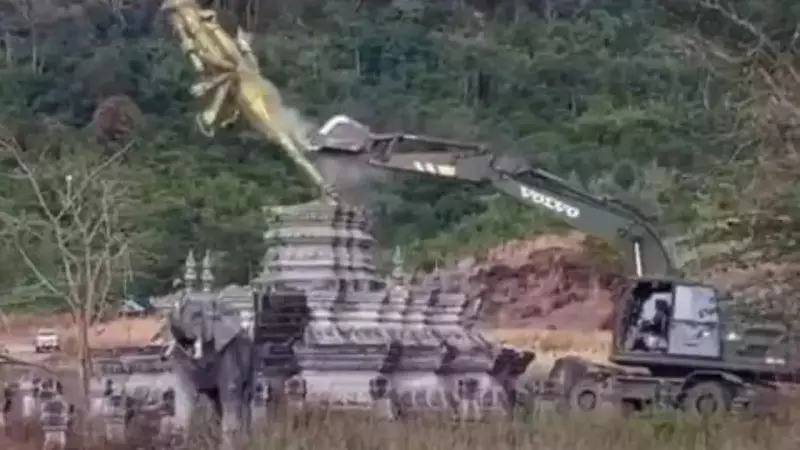
Thailand has sparked a diplomatic reaction from India after it demolished a statue of Lord Vishnu located in a disputed border area with Cambodia. The Thai government, facing criticism, has described the religious icon as merely a "decorative structure" with no formal religious significance.
Thailand's Justification and India's Strong Condemnation
On Thursday, the Thai government formally defended the action, stating the structure was "not connected to any religion" and was simply a decorative piece along the Thailand-Cambodia frontier. In an official statement, Bangkok clarified that the removal was driven by security considerations and area administration and was not intended to insult any faith.
Prime Minister Anutin Charnvirakul echoed this stance, telling reporters that "a destroyed statue cannot compare to soldiers’ lives or limbs." The government expressed "sincere regret for any discomfort" caused by the circulation of images showing the idol being torn down by a backhoe.

India's Ministry of External Affairs reacted sharply a day earlier. It stated that "such disrespectful acts hurt the sentiments of followers around the world, and should not take place." Emphasizing the regional cultural heritage, India added that Hindu and Buddhist deities are deeply revered across the region.
The Border Dispute and Conflicting Territorial Claims
The demolition incident occurred against the backdrop of renewed military clashes between Thailand and Cambodia. The conflict this month has resulted in significant casualties, with 23 deaths reported in Thailand (mostly soldiers) and 21 civilian fatalities in Cambodia, according to official figures.
Videos verified by AFP showed the statue being destroyed near the disputed An Ses area. A Cambodian government spokesman from Preah Vihear province asserted that the statue was "inside our territory" and condemned the destruction of ancient statues worshipped by Hindu and Buddhist followers. A check on Google Maps indicated the idol stood approximately 400 metres from the border on the Cambodian side.
Cambodia has repeatedly accused Thai forces of damaging temple ruins during recent clashes, allegations that Thailand denies.
Broader Implications and Regional Sentiments
This event highlights the complex interplay between territorial sovereignty, security, and religious sensitivity in Southeast Asia. While Thailand frames the act as a necessary security measure in a contested zone, India and Cambodia view it through the lens of cultural and religious preservation.
The Thai government's statement that the site was "not installed as a registered or officially recognised religious site" forms the core of its defence. However, for millions of followers, the religious significance of a deity's idol often transcends formal bureaucratic recognition.
The incident adds a layer of cultural diplomacy to the ongoing border tension between the two Southeast Asian nations, drawing in India, which shares deep civilizational links with the region through Hinduism and Buddhism.






