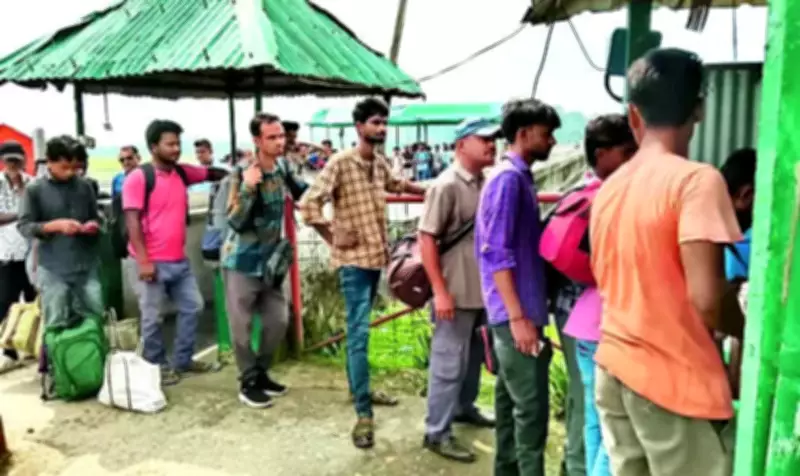
Madhubani: Nepal’s recent strict enforcement of an existing customs rule—imposing duties on goods valued above NPR 100 (approximately Rs63) brought from India—has significantly disrupted informal and small-scale cross-border trade along the India-Nepal border.
Impact on Local Trade and Consumers
This policy, already in place but implemented casually on household items earlier, applies duties ranging from 5% to 80% depending on the item category, plus additional VAT in many cases. The sudden strict enforcement has left common people in Nepal in a quandary, while adversely impacting small traders on the Indian side. Markets dotting the India-Nepal border thrive majorly on Nepalese consumers, said Bimal Maskara, a social worker and secretary of Nav Jeewan Charitable Trust.
General secretary of Jaynagar Chamber of Commerce, Anil Bairoliya, said household articles, electronic goods, and medicines are purchased by people of bordering Nepal villages at Jaynagar (Madhubani). As these items of daily consumption are now subject to strict tax rules, people across the border have stopped visiting Jaynagar. He said Indian women married in Nepal even feel embarrassed as they fail to carry gifts from India to their matrimonial homes for fear of even small items being taxed.

Reverse-Smuggling and Economic Shifts
However, on-the-ground implementation, resulting in rigorous checks by Nepal’s Armed Police Force (APF) and customs officials, has turned out to be a big bonanza for big traders across the border. Sort of reverse-smuggling of goods from India to Nepal has begun, sources said. In Madhubani’s Jaynagar and surrounding markets, wedding-season business has suffered heavily because of strict tax implementation, said Lalit Jha, a resident of Jaynagar.
Social and Cultural Strains
Sanjib Kumar Jha of Mirchaiya village in Sirha district of Nepal said besides the disruptions of household purchases, social and cultural relations are seemingly under strain. He said, “Girls married in India cannot carry gifts while visiting their parents’ house in Nepal for fear of Bhansar.” Another Nepali citizen, Pawan Jha of Dhanukha district, said: “Increasing discontent among people has prompted Mahanth Thakur, member of Nepal’s Upper House, and chairman of Janta Samajwadi Party to reconsider the decision.”
Calls for Integrated Check Post
Secretary of Jaynagar Chamber of Commerce also said a memorandum was recently submitted to Nityanand Rai, minister of state for home affairs, Government of India, for the establishment of an Integrated Check Post (ICP) at Jaynagar to ease cross-border trade and reduce the burden on small traders and consumers.