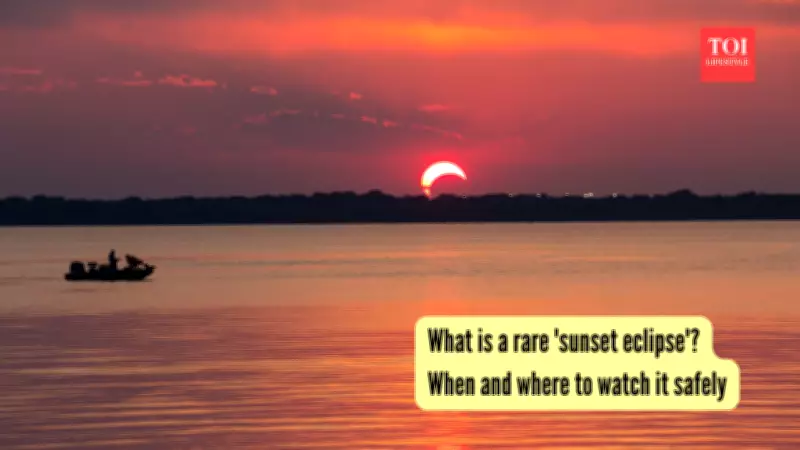
Solar eclipses are among the most magical celestial events, transforming day into dusk, lowering temperatures, silencing birds, and revealing the Sun's ghostly corona. This year, a particularly special solar eclipse is approaching, with unique twists that make it even more remarkable. The upcoming solar eclipse, known as a 'sunset eclipse,' will occur in the coming months, but what exactly is it and why does it have that name? Let us explore.
What Is a 'Sunset Eclipse'?
A sunset eclipse is a solar eclipse that takes place low on the horizon as the Sun is setting. According to NASA, for many observers along the western part of the path, the Sun will set while still partially eclipsed, creating a stunning sunset eclipse. In Spain, this event will occur during the golden hour, when the Sun sits low in the sky. As BBC Sky at Night notes, the oncoming twilight could enhance the mesmerizing display. Over the Mediterranean waters, the view will remain largely unobstructed at the horizon, making it one of the best locations to witness the eclipse.
When and Where to Watch the Rare Sunset Eclipse
This rare phenomenon will take place on August 12, 2026, when a total solar eclipse will sweep across several countries. According to NASA, it will be visible across Greenland, Iceland, northern Russia, the Atlantic Ocean, Spain, and a small part of Portugal. This marks the first time such a rare eclipse will be visible in mainland Europe since 1999, ending a wait of over 27 years. For Spain, the gap is even longer, with the last totality over the Iberian Peninsula occurring in 1912.

How to Watch the Totality of the Eclipse
According to NASA, most people in the path will experience less than two minutes of totality. Near the center over Greenland, Russia, or the North Atlantic, totality will last under two and a half minutes.
Will the Rare Sunset Eclipse Be Visible in India?
The sunset eclipse will not be visible in India. The path of the phenomenon remains over the Arctic, the North Atlantic, and Europe, far from Indian skies. Although a few eclipse calculation sites suggest a tiny partial eclipse with around 14 percent obscuration in the extreme northern parts of India, near Ladakh and Jammu and Kashmir, NASA's visibility map does not include India.
Tips to Watch a Solar Eclipse Safely
- Do not look directly at the Sun, as even a thin ray of sunlight can damage your eyes.
- Use proper eclipse glasses that meet the ISO 12312-2 standard. Regular sunglasses are not dark enough for safe viewing.
- If you do not have glasses, try watching indirectly using a simple pinhole projector to enjoy the show on a flat surface.
Stay tuned for more lifestyle news and trends. For updates, follow the TOI App.