This week's developments from China highlight a complex mix of diplomacy, domestic governance, and historical tensions. The visit of French President Emmanuel Macron to Beijing underscored persistent challenges in China-Europe relations. Concurrently, Hong Kong's Legislative Council elections recorded a notably low voter participation, reflecting public sentiment following a recent tragedy and political changes. Meanwhile, historical grievances resurfaced as Japan and China exchanged sharp words ahead of the anniversary of the Nanjing Massacre.
Macron's Beijing Visit: Diplomacy Without Major Breakthroughs
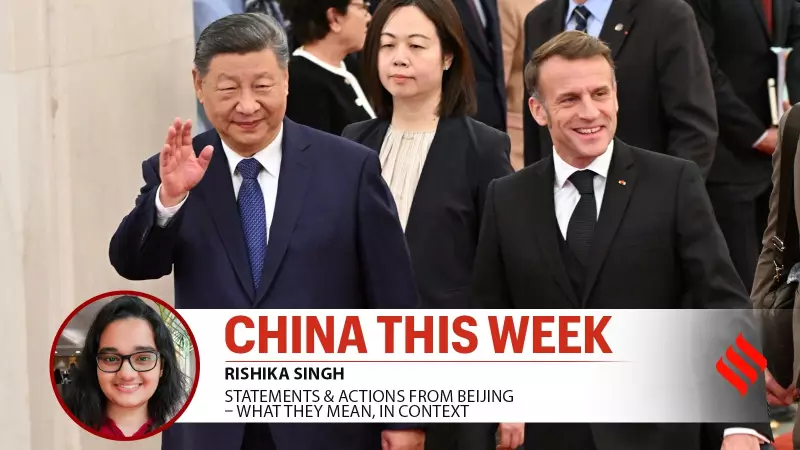
French President Emmanuel Macron was on a state visit to China from December 3 to 5, 2025. He met with Chinese President Xi Jinping at the Great Hall of the People in Beijing. While Macron expressed gratitude for the "warm welcome," the summit concluded without significant new agreements, pointing to unresolved disputes on trade and foreign policy.
The leaders discussed cooperation on nuclear energy, reaffirming a commitment to promote its safe development. On global conflicts, they expressed support for a two-state solution for Israel and Palestine. Macron sought China's assistance in ending the war in Ukraine. In response, Xi stated that "China supports all efforts that work towards peace" but stopped short of a concrete pledge.

The broader context reveals deep-seated issues. China's trade surplus with the European Union, and specifically France, remains a major point of contention. A report indicates that China accounts for a staggering 46% of France's total trade deficit. European Commission President Ursula von der Leyen had earlier described the relationship as being at an "inflection point," calling for rebalancing. Despite shared interests in climate change and the green economy, disagreements over China's close ties with Russia and trade imbalances continue to hinder a closer alignment between Beijing and European capitals.
Hong Kong's Legislative Council Election: Apathy and Grief
Elections for Hong Kong's Legislative Council were held on Sunday, December 7, 2025. The voter turnout stood at approximately 30.4%, according to the South China Morning Post. This figure is marginally higher than the record low of 30.2% in 2021 but is significantly lower than the 52.57% recorded at a similar point in the 2016 polls.
Analysts point to two primary factors for the subdued participation. The first is widespread public grief and anger following a catastrophic fire in a residential complex in November 2025, which claimed over 159 lives. The tragedy, blamed on substandard construction materials, has deeply shaken the city. Authorities cautioned foreign media against spreading "false information" about the government's response, as per a Reuters report.
The second, more structural factor, involves political reforms enacted by Beijing. In recent years, the electoral landscape in Hong Kong has been reshaped to ensure only "patriots" govern. The number of directly elected seats was reduced, and candidates must pass a national security screening. These changes follow the large-scale pro-democracy protests of 2019 and a subsequent crackdown, which have led to a growing sense of political disillusionment among many residents, contributing to the declining electoral engagement.
Japan-China Frictions and the Shadow of History
Geopolitical tensions between China and Japan have intensified, coinciding with the sensitive anniversary of the Nanjing Massacre. The Japanese embassy in China issued a safety advisory, warning its citizens that "anti-Japanese sentiment tends to rise on days related to historical issues." It advised people to avoid clothing or items that identify them as Japanese in the coming days.
The immediate trigger was a recent statement by Japanese Prime Minister Sanae Takaichi, who said Japan would defend itself if China launched a military campaign over Taiwan. A Chinese official responded with a violent online threat, exacerbating the diplomatic spat.

This exchange is layered over a painful historical backdrop. The Nanjing Massacre began on December 13, 1937, when Japanese troops captured the city. Over several weeks, Japanese forces are historically documented to have killed between 100,000 and 300,000 Chinese civilians and disarmed soldiers. After World War II, Japanese commander Matsui Iwane was tried and executed for his role. The memory of this event remains a potent nationalist symbol in China, while some factions in Japan have periodically sought to downplay its severity, ensuring it remains a recurring flashpoint in bilateral relations.
In summary, the week presented a China navigating delicate international partnerships, managing governance in Hong Kong, and confronting historical animosities that continue to shape its present-day geopolitical stance.