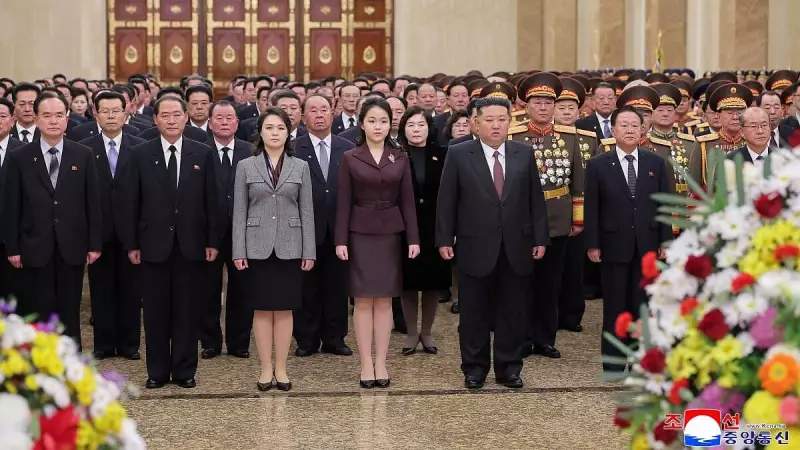
North Korean leader Kim Jong Un's daughter, Kim Ju Ae, has made a significant public appearance, visiting a major state mausoleum. This event, reported by state media, adds substantial weight to the ongoing discussion among international observers about her political future.
A Growing Public Profile
Over the past three years, Kim Ju Ae has been featured with increasing prominence in official North Korean media outlets. Her appearances, often alongside her father at major military and public events, have shifted from rare sightings to regular fixtures. This consistent visibility is a marked departure from the traditionally secretive nature of the Kim family's private lives and is interpreted by many as a deliberate strategy.
The latest appearance, a visit to a state mausoleum, is seen as particularly symbolic. Such sites in North Korea are deeply tied to the legacy of the ruling family and the nation's revolutionary history. Her participation in a solemn event of this nature is a strong signal of her elevated status within the regime's hierarchy.
Analysts Weigh In on Succession Possibilities
The curated public rollout of Kim Ju Ae has not gone unnoticed by experts who study the isolated nation. Analysts and South Korea's National Intelligence Service (NIS) have long speculated that these moves are preparatory. The dominant theory suggests that she is being groomed to eventually become North Korea's fourth-generation leader, continuing the dynastic rule established by her great-grandfather, Kim Il Sung.
While Pyongyang has made no official declaration regarding succession plans, the systematic nature of her introductions suggests a long-term strategy. Experts point out that building her public image and associating her with state power and legacy is a classic step in establishing a successor's credibility within the country's unique political system.
Implications for the Korean Peninsula
The potential anointing of Kim Ju Ae as a future leader carries significant implications for regional stability and diplomacy. A succession process in a nuclear-armed state like North Korea is a period of inherent uncertainty watched closely by governments in Seoul, Washington, and Tokyo.
If the speculation proves accurate, it would solidify the Kim family's dynastic control for decades to come. The international community will be monitoring how her potential role is framed domestically and what policies, if any, might be associated with her rise. For now, her visit to the state mausoleum on January 2, 2026, stands as the latest and one of the most potent pieces of evidence in an unfolding political narrative.
The world continues to watch North Korea's next moves, parsing state media reports for clues about the future of its leadership. The story of Kim Ju Ae is clearly one of the most critical developments to follow in understanding the Hermit Kingdom's path forward.