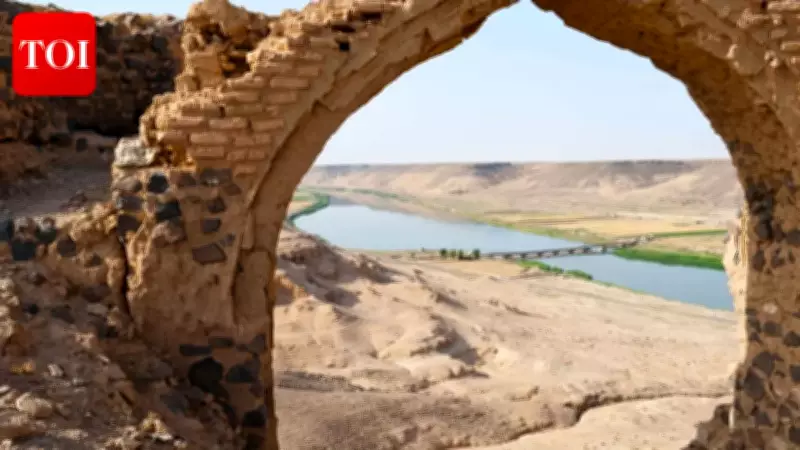
Researchers have finally discovered the origins of the Euphrates River, a waterway that nourished the cradle of civilisation. A breakthrough study published in Nature Geoscience uncovered how this river, famously mentioned in the Bible's account of the Garden of Eden, came into existence.
Biblical and Historical Significance
In biblical literature, the Euphrates appears as one of four rivers flowing through the Garden of Eden in Genesis. It is mentioned over fifty times throughout scripture, including in Revelation, where its drying up precedes the Battle of Armageddon. Historically, the river stretches 1,740 miles through Turkey, Syria, and Iraq. Along with the Tigris, it provided water for Mesopotamia, also known as the Fertile Crescent, which flourished around 6,000 years ago.
Scientific Discovery
Contrary to biblical accounts, the river's origin remained a mystery until now. An international team of researchers found that the Euphrates formed from the convergence of two rivers flowing from Turkey to the arid Mediterranean Basin between 3.6 million and 1.6 million years ago. These ancient rivers, the Palaeo-Murat and Palaeo-Karasu, merged to create the modern Euphrates.

Study first author Andrew Madof, a senior seismic stratigrapher at Chevron, stated: "The modern landscape onshore, along with buried sediments offshore, still preserves clear signs of the ancient Euphrates River. If the Palaeo-Murat and Palaeo-Karasu rivers had not switched course and merged when they did, it is unclear whether the Fertile Crescent would have formed in the way it did."
Unexpected Breakthrough
The discovery came unexpectedly in 2014 when Madof was conducting seismic imaging surveys off Lebanon's coast while searching for natural gas. He noticed unusual patterns and river sediment atop large underwater salt deposits formed over five million years ago during the Messinian Salinity Crisis, when the Mediterranean Sea partially or completely dried out. Intrigued, the team traced the sediments using satellite data, geological mapping, and advanced imaging techniques.
Ancient River Systems
They discovered two giant rivers: the Palaeo-Karasu, dating back 16.5 million years, and the Palaeo-Murat, existing between 8.6 million and 5.9 million years ago. One river was larger than the Nile today, while the other exceeded the combined size of the Tigris and Euphrates. These rivers flowed into the dried Mediterranean for about 120,000 years. Over millions of years, tectonic activity altered their courses until they merged into the Euphrates.
Geophysicist Angelo Camerlenghi remarked: "I think this may be the end of a discussion that has lasted decades."