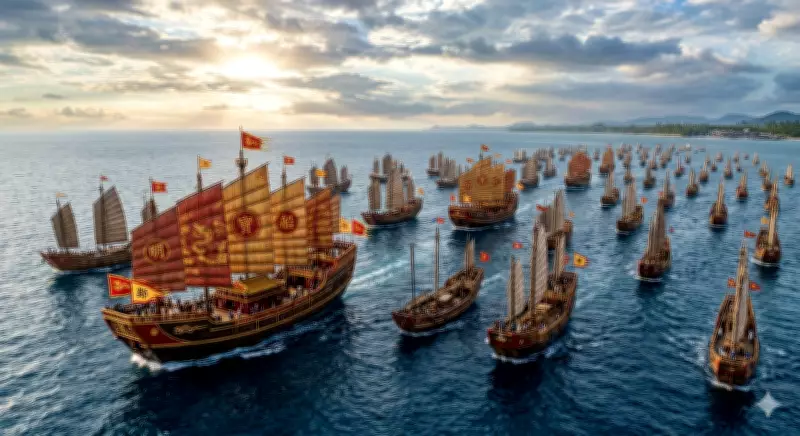
The Rise and Fall of China's Treasure Fleet
At the dawn of the 15th century, China boasted the most formidable navy the world had ever witnessed. This legendary armada, famously known as the Treasure Fleet, was commanded by the illustrious Admiral Zheng He. It embarked on ambitious voyages deep into the Indian Ocean, reaching as far as East Africa and the Middle East. These expeditions served as a powerful testament to China's unparalleled dominance in technology, economic prowess, and international diplomacy long before European empires began their ascent.
Unmatched Naval Power of the Ming Dynasty
The Ming Dynasty's Treasure Fleet was a marvel of both technological innovation and organizational excellence. Between 1405 and 1433, Admiral Zheng He spearheaded seven major expeditions, each involving hundreds of vessels and tens of thousands of skilled sailors. The fleet featured the largest wooden ships ever constructed, showcasing advanced shipbuilding techniques that were centuries ahead of their time.
These journeys were not intended for conquest but rather for diplomacy, commerce, and the expansion of Chinese influence across the globe. As noted by Dr. Sam Willis in a podcast with Professor Tim Brook, a historian of China at the University of British Columbia, "Zheng He’s maritime expeditions underscored China’s supremacy at sea." During this period, China likely stood as the world's most powerful nation in terms of naval strength and economic capacity, far surpassing contemporary European states.

The Sudden Abandonment of Maritime Ambitions
Despite its resounding success, the Treasure Fleet met an abrupt and premature end. Shifting political dynamics within the Ming court played a crucial role in this reversal. Confucian bureaucrats, who held significant sway, viewed these oceanic explorations as frivolous and ethically questionable. They advocated for a focus on agricultural stability and internal affairs over foreign trade and expansion.
Following the death of Admiral Zheng He, support for the expeditions rapidly dwindled. The ventures were increasingly perceived as extravagant and unnecessary. By the 1520s, China had imposed severe restrictions on maritime trade, drastically reduced shipbuilding activities, and even destroyed valuable records documenting the voyages. This inward turn effectively distanced China from global engagements, just as European nations began their aggressive expansion across the seas.
A Historic Mistake That Reshaped Global Power Dynamics
Many historians argue that China's decision to abandon the Treasure Fleet created a vacuum that European powers were quick to fill. According to Kenneth Pomeranz in his seminal work "The Great Divergence," "The cessation of Chinese maritime expansion made possible advantages which European powers would shortly take advantage of." While China retreated from the oceans, nations like Portugal and Spain surged forward, ultimately transforming global trade networks and establishing vast overseas empires.
This pivotal shift occurred within mere decades, marking a dramatic reconfiguration of world influence. Had the Ming Dynasty continued its maritime expeditions, China could have maintained control over global exploration, potentially altering the course of trade, colonization, and cultural exchange on an unprecedented scale.
Enduring Lessons from a Lost Opportunity
The story of the Chinese Treasure Fleet transcends mere historical narrative; it serves as a poignant lesson in missed opportunities. At a time when China stood as a preeminent global superpower, the choice to embrace isolation over growth irrevocably changed the trajectory of history. This decision allowed other nations to seize leadership in domains where China once led.
Modern scholars now regard this episode as a critical case study for strategic decision-making. It highlights the long-term repercussions of shunning innovation and disengaging from the wider world. The tale of the Treasure Fleet reminds us that in an interconnected global landscape, retreat can often pave the way for others to advance.