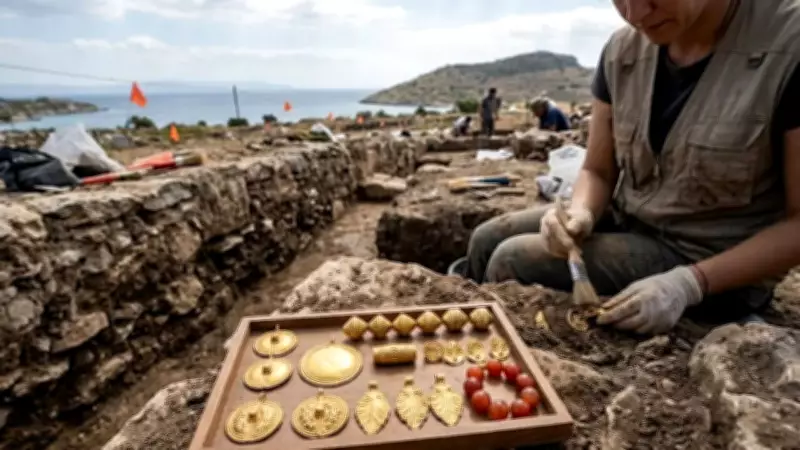
Researchers have uncovered a stunning collection of gold jewellery from the Middle Bronze Age at the Kolona site on the Greek island of Aegina. The Greek Ministry of Culture officially announced the discovery on April 22, 2026, with the artefacts dating back to the first half of the second millennium BCE. This find provides significant new insights into the elite identities of the ancient Aegean and their extensive trade networks.
Discovery Details
The 2025 excavation at Kolona, led by the University of Salzburg in collaboration with the Austrian Archaeological Institute, revealed a cohesive grouping of gold pendant beads and carnelian ornaments. These items most likely formed a high-status necklace, further highlighting Aegina's ancient role as a key player in the larger Mediterranean trading system. The excavation focused on a large stone-built structure just outside the Middle Bronze Age defensive walls. Although the area had been disturbed and the stratigraphy altered, the artefacts were found in excellent condition.
The recovered items include: eight bipartite disc-shaped pendants, one disc-shaped pendant, seven biconical gold beads, one cylindrical gold bead, eight gold leaf ornaments, and seven spherical carnelian beads. Additionally, 12 fragments of copper and a needle or pin indicative of a possible burial were found, though no skeletal remains have been discovered.

Connections to the Aegina Treasure
Researchers have noted remarkable similarities between the newly discovered objects and the controversial so-called Aegina Treasure, a collection of prehistoric gold and semi-precious stones found on Aegina that was illegally exported to the British Museum in 1892. The resemblance in the design of the disc-shaped pendants reinforces the hypothesis that Aegina was at the centre of an extensive trade and artistic exchange network. The use of materials such as carnelian, which originated outside Aegina, suggests that the island's inhabitants were part of a long-distance trading system extending from mainland Greece to the Cyclades and Minoan Crete.
Significance and Future Study
The excavation at Kolona is being led by Professor Alexander Sokolicek under the supervision of the Ephorate of Antiquities of Piraeus and Islands. This discovery challenges many existing theories about Kolona. While the Temple of Apollo at Kolona was traditionally dated to the 6th century BCE, this find demonstrates that the site was used as a prehistoric community, a sacred site, and an ancient acropolis. Consequently, authorities have decided to keep the artefacts on Aegina to facilitate further study, ensuring the site continues to serve as an important reference for understanding settlement patterns along the Saronic Gulf.
This remarkable discovery not only enriches our understanding of Bronze Age Aegean societies but also underscores the importance of continued archaeological research in the region.