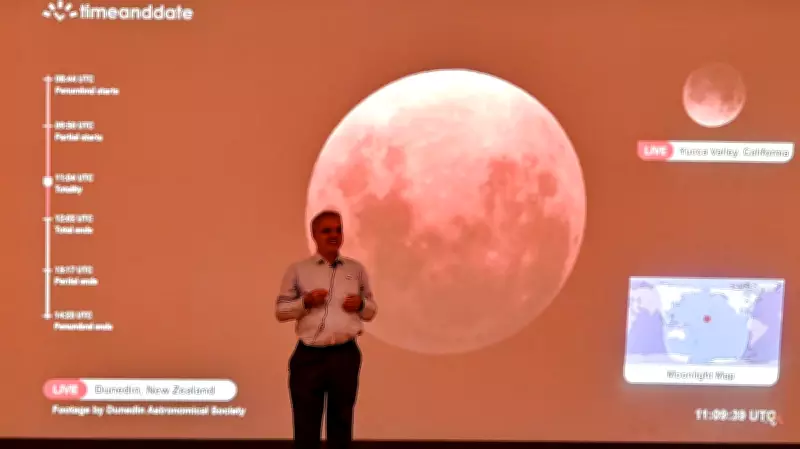
Bengaluru Catches Final Glimpse of 2026's First Total Lunar Eclipse
In a stunning celestial display, Bengaluru residents were treated to the final glimpse of the first total lunar eclipse of 2026. This astronomical event, which drew significant attention from skywatchers and enthusiasts across the city, offered a rare opportunity to witness the moon's dramatic transformation as it passed through Earth's shadow.
Details of the Celestial Phenomenon
The total lunar eclipse, a phenomenon where the Earth aligns directly between the sun and the moon, cast a reddish hue on the lunar surface, often referred to as a blood moon. Observers in Bengaluru reported clear skies in many areas, allowing for an unobstructed view of the eclipse's peak phases. The event began in the late evening and continued into the early hours, with the total phase lasting for approximately an hour, providing ample time for photography and observation.
Public Engagement and Skywatching Activities
Local astronomy clubs and educational institutions organized special viewing sessions to capitalize on this rare event. Enthusiasts gathered at parks, rooftops, and designated observation points equipped with telescopes and binoculars to enhance their experience. Social media platforms were flooded with images and videos captured by residents, showcasing the eclipse's progression and the vibrant colors of the moon.

Experts highlighted that this eclipse is part of a series leading up to the more prominent total lunar eclipse expected in 2026, making this glimpse a precursor to future celestial events. They emphasized the importance of such occurrences in fostering public interest in astronomy and science education.
Scientific Significance and Future Predictions
From a scientific perspective, lunar eclipses provide valuable data for researchers studying the Earth's atmosphere and lunar geology. The reddish tint observed during totality is caused by Rayleigh scattering, where Earth's atmosphere filters sunlight, allowing only longer red wavelengths to reach the moon. This event also served as a reminder of the predictable nature of celestial mechanics, with astronomers already mapping out future eclipses for the coming decades.
Looking ahead, skywatchers in Bengaluru and across India can anticipate more lunar and solar eclipses in the near future, with the next significant total lunar eclipse in the region projected for 2026. Authorities and astronomy groups are encouraged to plan ahead to ensure optimal viewing conditions and public safety during these events.
In summary, the final glimpse of the 2026 first total lunar eclipse in Bengaluru was not only a visual spectacle but also an educational moment that brought communities together under the night sky. As residents reflect on this experience, the anticipation builds for the next celestial wonders on the horizon.