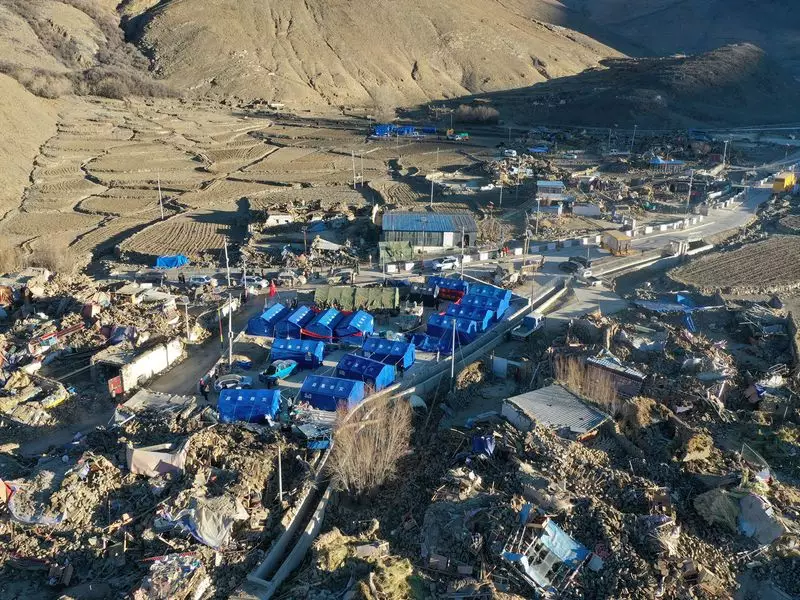
A light but noticeable earthquake struck the Tibet region early on Monday morning, sending tremors through the area. The seismic event, which registered a magnitude of 3.8, occurred at a significant depth, according to data from the National Center for Seismology (NCS).
Details of the Seismic Event
The earthquake's epicenter was located in Tibet, with precise coordinates placing it at a latitude of 34.31 degrees North and a longitude of 82.53 degrees East. The tremor originated at a considerable depth of 80 kilometers beneath the Earth's surface. This depth is a crucial factor, as deeper earthquakes typically cause less surface shaking compared to shallow ones of similar magnitude.
The seismic event occurred at 5:46 am Indian Standard Time (IST) on Monday. Despite the early hour, the tremor was reportedly felt in some parts of the region. The National Center for Seismology, which operates under India's Ministry of Earth Sciences, was quick to provide and share the details of the event through its official social media channels.

Impact and Initial Reports
As of the latest reports, there have been no immediate accounts of casualties or damage to property resulting from the earthquake. The magnitude of 3.8 is classified as a minor or light earthquake. Such events are often felt by people indoors, especially on upper floors of buildings, but rarely cause significant destruction.
The region of Tibet, situated on the Tibetan Plateau, is no stranger to seismic activity. It lies in a seismically active zone due to the ongoing collision of the Indian and Eurasian tectonic plates. This geological process, which also created the Himalayan mountain range, makes the area prone to earthquakes of varying intensities.
Understanding the Seismic Context
While this particular event was relatively mild, it serves as a reminder of the persistent seismic risk in the region. Monitoring by agencies like the NCS is vital for understanding patterns and providing early warnings for potentially larger events. The depth of 80 km likely helped mitigate any strong surface-level effects, preventing what could have been more noticeable shaking or minor damage from a shallower quake.
Authorities and disaster management teams in the region routinely monitor such activity. The swift reporting by the National Center for Seismology highlights the improved tracking and communication systems in place for seismic events in and around the subcontinent. Residents in seismically active zones are often advised to be prepared with basic safety measures, knowing how to "Drop, Cover, and Hold On" during shaking.
This earthquake follows a pattern of frequent, low-intensity tremors that characterize the complex geology of the Himalayas and the Tibetan Plateau. Scientists continuously study these events to better assess the accumulated stress along fault lines, which contributes to long-term seismic hazard assessment for the broader region, including northern India.